InvGate is built for IT service management and asset tracking. Evercycle is built to execute the physical hardware lifecycle across deployment, repair, retrieval, and disposition. This comparison explains where each platform fits and why IT teams increasingly need both layers covered.
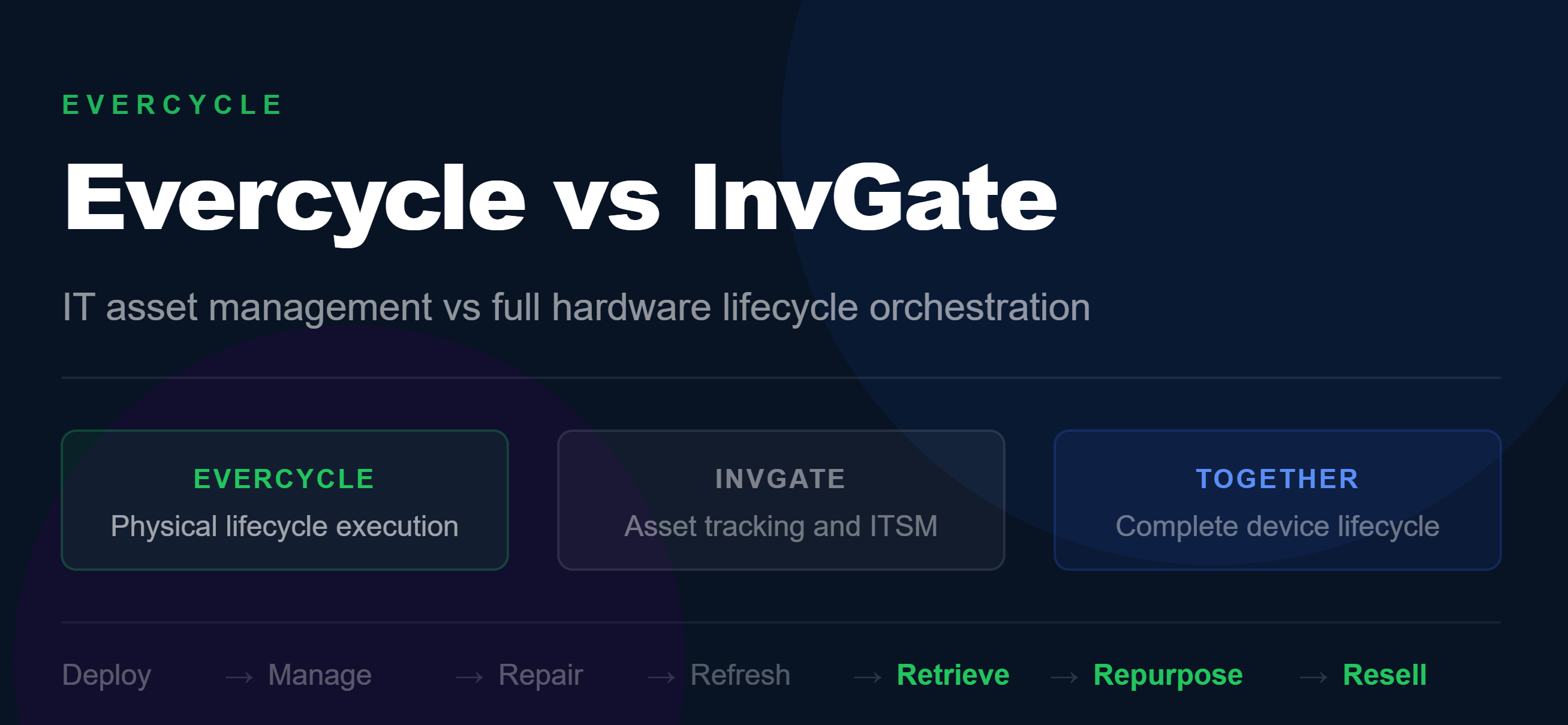
Every enterprise device goes through the same lifecycle: it gets deployed, assigned, managed, repaired when something breaks, refreshed when it ages out, retrieved when an employee leaves, and eventually redeployed, resold, or disposed of responsibly. That lifecycle has two layers. The first is the data layer: knowing what you own, who has it, and what its status is. The second is the operational layer: actually executing what needs to happen to each device at each stage.
InvGate is built for the data layer. It is a strong IT service management and asset tracking platform that excels at maintaining the asset record, managing service requests, and tracking software licenses. Evercycle is built for the operational layer. It orchestrates the physical execution of the hardware lifecycle across deployment, repair, retrieval, redeployment, buyback, and disposition.
The two platforms address different problems. This post explains where each fits, maps them against the full device lifecycle, and helps you figure out which one belongs in your stack.
InvGate offers two core products: InvGate Service Management and InvGate Asset Management. They are often sold together and work as a unified ITSM and ITAM platform.
On the service management side, InvGate handles incident management, service requests, problem management, and change workflows. For IT teams running a help desk or managing internal SLAs, it is a mature and capable platform.
On the asset management side, InvGate provides hardware discovery, software license tracking, asset inventory, and CMDB capabilities. Its offboarding workflow can surface what assets a departing employee has and route an approval to confirm what needs to be returned.
For organizations that need a single platform to manage their service desk and maintain visibility into what hardware and software they own, InvGate is a legitimate choice.
InvGate's offboarding workflow creates a retrieval task. It tells IT what needs to come back and updates the asset record when the device is returned. That is where it ends.
The operational work of actually recovering the device falls entirely outside the platform. Generating a pre-paid shipping label, sending the employee return instructions, tracking the package in transit, escalating to a manager when there is no response, routing the device to an ITAD vendor on arrival, and documenting the chain of custody from retrieval through data erasure: none of that happens in InvGate.
The same gap exists across the rest of the physical lifecycle. InvGate does not orchestrate device deployment logistics, manage device refresh programs across distributed teams, route devices to repair vendors, handle redeployment workflows, or manage residual value and buyback programs.
InvGate manages the record. What happens to the physical device is a separate operational problem.
Enterprise device fleets move through a consistent lifecycle. The table below maps each stage to what InvGate and Evercycle each handle.
The table below covers the full capability set across both platforms based on available product documentation.
InvGate is the right choice if your primary need is:
Evercycle is the right choice if your primary need is:
Many teams use both:
InvGate manages the service layer and maintains the asset record. Evercycle handles the physical execution when a device needs to be deployed, repaired, returned, or disposed of. The two platforms address different layers of the same operational problem and are not mutually exclusive.
Every IT team eventually faces the same realization: knowing what you own is not the same as managing what happens to it. InvGate gives you visibility and service management. Evercycle gives you the operational execution layer that turns a record into an action.
Most mature IT operations need both. InvGate handles the service desk and the asset database. Evercycle handles the physical lifecycle from the moment a device ships to the moment it is decommissioned. If your organization is running devices across a distributed workforce and the gap between your asset record and your actual operational reality is growing, that is the problem Evercycle was built to close.
Book a demo to walk through how Evercycle fits into your existing stack and where it picks up where your current tools leave off.





.png)