The gap is real. In a 2022 survey of 213 US senior IT professionals, Computerworld reported that 50% said their organization lost at least 5% of IT assets during employee departures. The survey was sponsor-associated and covered offboarding broadly, not only retired hardware.
Chain of custody software creates a time-stamped, asset-specific record across every handoff and disposition event. It coordinates documentation and workflows. It does not physically process devices. This article covers what ITAD chain of custody means, why it matters, which features count, how the lifecycle works, and how to evaluate a platform.
Key Takeaways
- ITAD chain of custody is one device's documented history, from recovery authorization to final disposition.
- Good software ties custody events to asset identity, condition, sanitization evidence, approvals, and vendor activity.
- Prioritize unique IDs, scan-based handoffs, tamper-evident audit trails, role-based access, integrations, and exception alerts.
- Choose a platform that connects existing systems rather than adding another disconnected record.
What Is Chain of Custody Software for IT Asset Disposition?
What chain of custody means in ITAD
Chain of custody is the chronological record of who possessed an asset, where it was, when each transfer happened, why, and what condition it was in. NIST's glossary describes it as documenting each handler, the date and time of transfer, and the purpose.
Inventory is different. Inventory says what you own. Custody documents control, movement, accountability, and final disposition.
A complete record links the asset tag and serial number to:
- Custody events and locations
- Users and vendors
- Approvals and attachments
- Disposition outcomes
Tracking, traceability, and custody
Location tracking shows where an asset was reported to be. Traceability reconstructs the sequence of events. Custody assigns accountability for each handoff.
Take a remote offboarding. A laptop moves from the employee to a carrier, then to an ITAD provider. A continuous chain needs more than a final "received" status. It needs:
- Authorization and the expected serial number
- Employee handoff confirmation with date, time, and packaging notes
- Carrier tracking bound to that device
- Intake scan reconciled against the expected asset
- Exceptions resolved, such as a mismatched serial number

What a defensible record should prove
The record should help show that the correct device was recovered, handled by authorized parties, sanitized according to procedure, and sent to an approved disposition path.
Software documentation supports audits, investigations, and customer reporting. It does not certify that sanitization or recycling was done properly.
Why Chain of Custody Matters for ITAD
Security and privacy risk
Gaps between employee possession, transport, vendor intake, sanitization, and disposition make it hard to show that a device holding sensitive data remained under control. Requirements vary by sector:
- FTC Safeguards Rule: covered financial institutions generally must dispose of customer information within two years of its last use, with exceptions.
- FACTA Disposal Rule: reasonable measures apply when selling, donating, or transferring computer equipment that held consumer report information.
- HIPAA Security Rule: final disposal and removal of ePHI before reuse are required. Recording movements is addressable. Security Rule documentation is kept six years.
- California Civil Code 1798.81: businesses must take reasonable steps to make customer records unreadable at disposal.
None of these rules makes software alone sufficient for compliance. None prescribes a universal per-device certificate.
Audit, legal, and customer accountability
Security, procurement, and risk teams get questions about one device at a time: last custodian, current status, sanitization evidence, downstream vendor, and disposition date. Searchable, exportable reports answer those faster than stitching together spreadsheets, emails, and vendor portals.
The cost of gaps can be steep. In a 2022 SEC order, Morgan Stanley Smith Barney paid a $35M penalty. A moving company involved in decommissioning sold roughly 4,900 IT assets, including unwiped drives. The SEC cited missing final-disposition certificates and chain-of-custody documentation, plus 42 missing devices.

Recovered value and responsible disposition
Better traceability means fewer lost assets, clearer exception handling, and more chances for reuse or resale. Gartner names asset type, age, condition, and resale channels as value drivers, so no universal per-device figure applies.
The Global E-waste Monitor reports the US generated 7,188 million kg of e-waste in 2022, with 4,052.8 million kg formally collected and recycled. That covers all electronics, not enterprise ITAD alone.
Essential Features of ITAD Chain of Custody Software
Unique identity and scan-based capture
Each asset needs a persistent identifier: asset tag, serial number, barcode, or QR code. Scans or structured mobile inputs should record every pickup, handoff, receipt, storage move, and processing step at the point of work, not afterward.
Audit trail and custody history
Each event should capture user identity, date and time, location, action, status, and reason. Unauthorized edits or deletions must be visible. NIST SP 800-53 AU-3 lists the audit content to look for, and AU-9 covers protecting audit records.
Authorized users should see a device's current custodian, last known location, open exceptions, and full history in seconds.
Transfer controls and condition documentation
Look for release-and-receive workflows, acknowledgments, condition checks, photos, and packaging notes. The workflow should flag:
- Mismatched serial numbers
- Damaged equipment or missing accessories
- Unreceived shipments
- Duplicate scans
Role-based access and vendor accountability
Permissions should separate employees, IT asset teams, carriers, repair partners, processors, recyclers, managers, and auditors. Each role should be limited to what it may view, edit, approve, or transfer.
Also verify:
- Individual accounts and authentication
- Approval controls and access reviews
- Retention rules and how vendor access ends
Keep permission to run workflows separate from permission to alter audit evidence.
Integrations and automation
The platform should connect with ITAM, CMDB, HRIS, endpoint management, ERP, shipping, and ticketing to avoid duplicate entry. One caution: Microsoft states that Intune Retire removes management without erasing device data, so MDM status is not sanitization proof.
Useful automation includes:
- Employee recovery messages
- Event-driven status changes
- Provider routing and overdue alerts
- Approvals and API sync
Reporting and evidence
Evaluate reports for:
- Asset-level histories and inventory by status or location
- Missing-device queues and sanitization evidence
- Disposition records and vendor performance
The system should link to certificates, work orders, shipping records, and photos. Those links document work completed outside the system. The software itself does not sanitize or recycle devices.
How Chain of Custody Software Works Across the ITAD Lifecycle
Authorization and identification
The workflow starts by identifying the device, confirming ownership and eligibility, and checking for legal holds. Legal holds matter at this stage: the Sedona Conference notes a hold can suspend routine destruction.
The initial record preserves:
- Asset data and data classification
- User or site context and expected accessories
- The approved next step
Recovery and first handoff
Offboarding creates a documented handoff to an internal team, carrier, or provider. Document each handoff with:
- Scan, date, and time
- Pickup location and condition notes
- Exceptions, plus alerts when a device doesn't return as expected
Transport, receipt, and processing
Carrier events should connect to ITAD intake, where the received device is reconciled against the expected one. Mismatches go to review.
Custody changes during inspection, repair, refurbishment, or storage should name the accountable role and link work orders.
Sanitization and disposition decision
The record should show:
- Sanitization status and method reference
- Responsible party and completion time
- Verification evidence
- Any approval needed before reuse, resale, recycling, or destruction
NIST SP 800-88 Rev. 2 (September 2025) supersedes Rev. 1 and defines three outcomes:
| Category | Meaning |
|---|---|
| Clear | Logical sanitization against simple, non-invasive recovery |
| Purge | Recovery infeasible with laboratory techniques; media stays usable |
| Destroy | Recovery infeasible; media can't store data again |

These are sanitization outcomes, not custody stages. The software records that they happened. The technical process happens elsewhere.
Final disposition and audit review
The chain closes with the disposition path, downstream processor, date, certificate, and any financial or sustainability data you keep. Auditors should be able to:
- Search one asset or filter the fleet by status or exception
- Export the history
- Spot unresolved gaps without combining systems by hand
How to Choose and Implement the Right Software
Map the workflow first
Document every participant, handoff, system, approval, exception, evidence type, and outcome across employee devices and site equipment. Then test candidates on a realistic scenario: remote offboarding, carrier transport, ITAD intake, sanitization, refurbishment, and resale or recycling.
Evaluate security, integration, and reporting
Ask vendors about:
- Identifier formats and scan or mobile capture, including offline use
- Tamper-evident audit records
- Role-based permissions and vendor access controls
- Retention, exports, and APIs
- Disaster recovery and data ownership
Integration matters because a platform that can't exchange reliable events with asset, HR, logistics, and vendor systems just adds reconciliation work. Keep three records distinct but connected:
- Custody workflow: who held the asset and when
- Sanitization evidence: proof of data destruction
- Downstream disposition records: reuse, resale, or recycling outcome

Where Evercycle fits
Evercycle is an enterprise platform that orchestrates the IT device lifecycle across existing vendors and systems. It offers unified visibility, event-driven workflows, automated vendor routing, employee communications, real-time chain-of-custody tracking, and audit reporting.
Capabilities include:
- Quick-scan receiving journals that check packages against expected devices
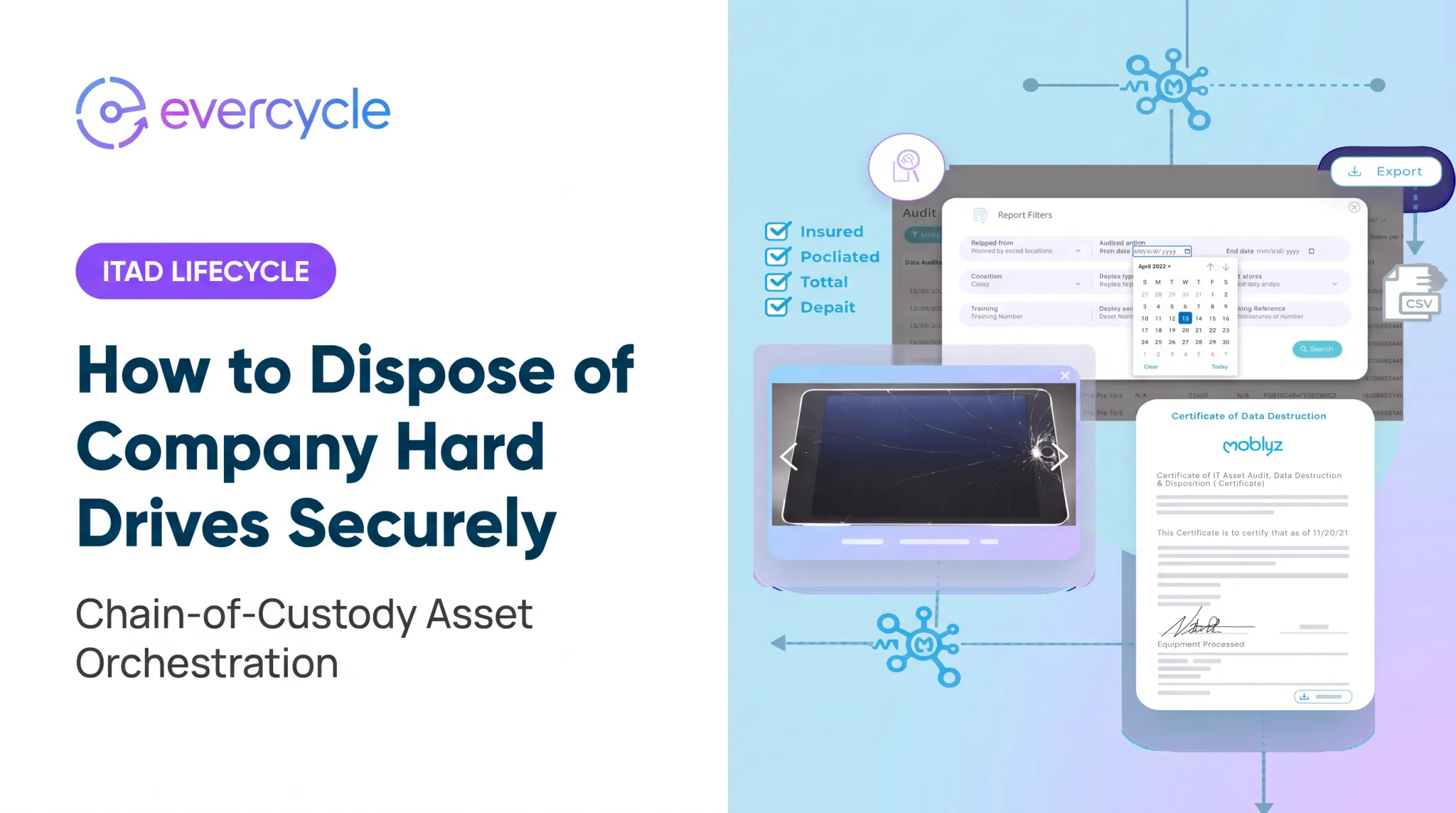
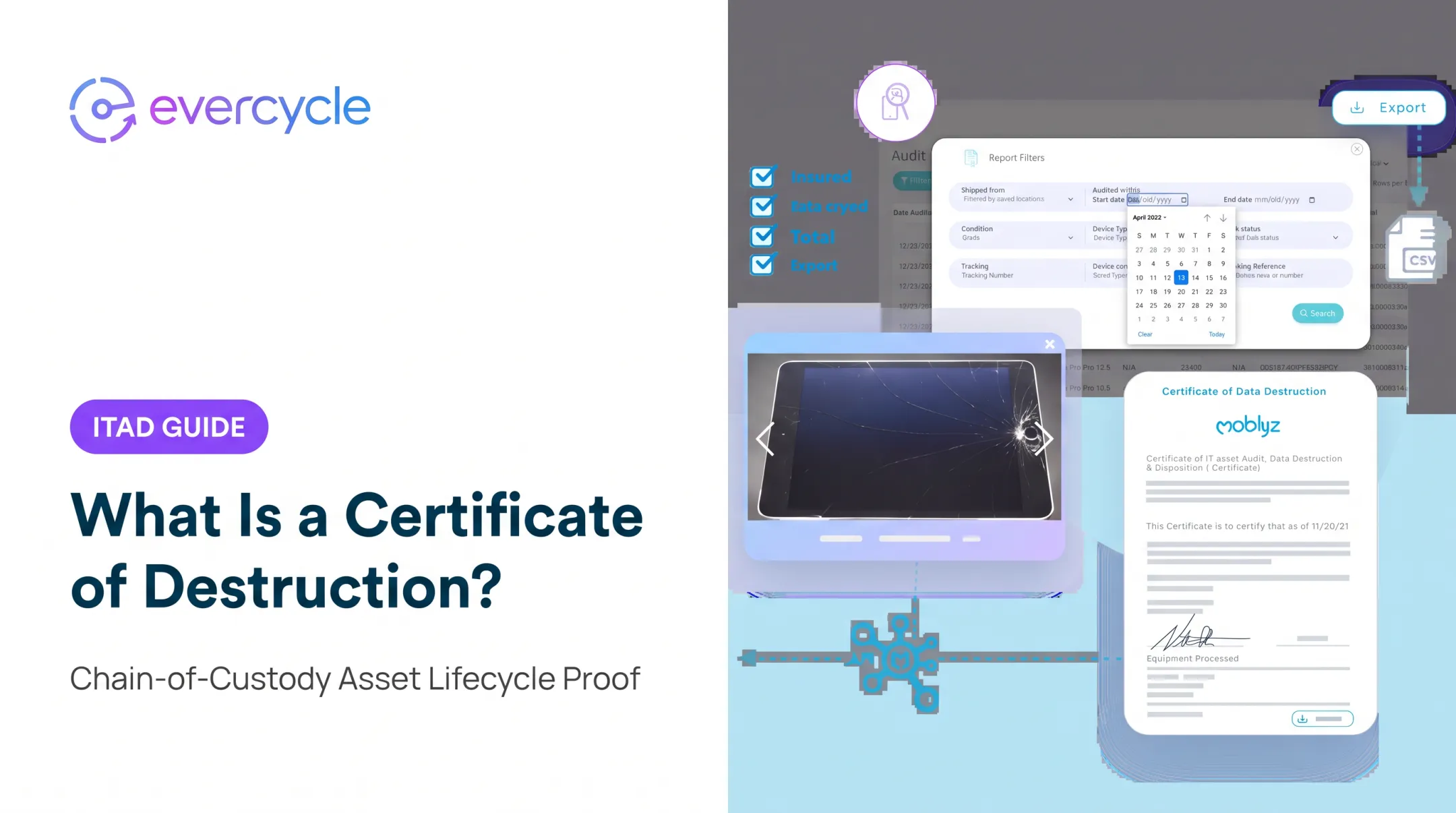
- Device audit reporting with damage photos and certificates of data destruction, viewable, filterable, and exportable
- Custom tracking fields, asset tags, and work order IDs
- REST API and webhooks, with integrations for ServiceNow, Intune, Jamf, and HRIS platforms
It suits enterprises, distributed IT teams, MSPs, and ITAD partners wanting an orchestration layer. Physical recovery, shipping, sanitization, repair, and recycling stay with the appropriate providers. Review encryption, authentication, and retention controls as part of your security evaluation.
Frequently Asked Questions
What is chain of custody tracking?
It's the documented, chronological history of an asset's handlers, locations, transfers, actions, and final disposition. For retired IT devices, it shows who held each one and what happened to it.
What is traceability used for?
Traceability reconstructs an item's movement and history. Organizations use it to investigate exceptions, support audits, verify accountability, and improve ITAD visibility.
Can you give me an example of data tracking?
A laptop leaves an offboarding employee, goes to a carrier, then an ITAD facility, sanitization, and final disposition. The software records the scans, timestamps, custodians, condition notes, sanitization results, and disposition outcome.
What is chain of custody in cybersecurity?
It's maintaining control and evidence of handling for devices or media that may hold sensitive data. Tracking supports that evidence but doesn't replace sanitization controls.
What are the two main types of traceability?
Backward traceability identifies an asset's prior source and handling history. Forward traceability shows where it goes next. For a retired laptop, one traces it to the departing employee, the other to its recycler.