Introduction
A remote employee gives notice. Their last day is Friday. The laptop is in a home office two time zones away. It holds customer data, and nobody is sure whether it should be wiped and reissued, repaired, sold, or recycled.
That scenario plays out constantly. An August 2026 TIGTA audit found 594 unlocated IRS IT assets with a recorded cost of $274,822. That is one agency, not a national benchmark, but the pattern is familiar.
IT reverse logistics is the coordinated movement and management of devices from employees, offices, customers, or field sites back to the organization or an approved provider. It is more than shipping a box. This article covers the return lifecycle, chain of custody, data sanitization, disposition, common risks, and the software that ties it together.
Key Takeaways
- Reverse logistics spans authorization, shipping, intake, sanitization, disposition, and record closure.
- Serial-level visibility and documented custody support security and audits.
- Standard routing rules increase reuse and recover more value.
- Orchestration software can connect your existing vendors and systems without replacing them.
What Is IT Reverse Logistics? Definition, Scope, and Value
ASCM defines reverse logistics as a supply chain dedicated to the reverse flow of products and materials for returns, repair, remanufacture, or recycling. That definition is general. In IT, the products are serialized, often hold sensitive data, and carry lease, warranty, and security obligations.
The neighboring terms overlap but differ:
- Returns management covers the immediate return process.
- Reverse logistics covers the full post-return journey.
- ITAD covers retirement through resale or recycling, including sanitization and reporting.
- Forward IT logistics covers procurement and deployment, while reverse flows handle offboarding, refresh recovery, repair, redeployment, resale, and disposal.
Which device events trigger a reverse logistics workflow?
Common triggers include:
- Employee offboarding or role changes
- Hardware refreshes and device swaps
- Warranty and repair requests
- Lease expirations
- Failed deliveries
- Office closures, reorganizations, and recalls
- End-of-life events
The devices vary: laptops, desktops, phones, servers, network gear, peripherals, and field-deployed kiosks, scanners, and sensors.
Who participates?
- Employees and field users return the device.
- HR and People Ops trigger the event and chase non-responders.
- IT asset teams own the record and routing.
- Information security sets sanitization requirements.
- Finance reconciles lease and asset records.
- Carriers, MSPs, repair providers, refurbishers, recyclers, and ITAD partners move, fix, or process the hardware.
What outcomes should the process support?
A managed program should deliver:
- Faster recovery and higher reuse rates
- Traceable assets with clear chain of custody
- Documented data protection and audit readiness
- Responsible end-of-life handling
E-waste volume underscores the stakes. The Global E-waste Monitor reports 62 billion kg of e-waste generated in 2022, with only 22.3% documented as properly collected and recycled. Those are global, all-electronics figures, not enterprise IT numbers.
How the IT Device Return Process Works
Initiate and authorize the return
Capture the following before anything moves:
- Asset tag or serial number
- Assigned user or site
- Reason for return
- Ownership or lease status and warranty details
- Return date, destination, accessories, and special handling
Give employees one clear set of instructions: approved packaging, a prepaid label, pickup scheduling, and an escalation path. Distributed workforces lose hardware when this step is vague.
Ship the device and maintain chain of custody
A reverse shipment moves an asset from its user or site back to the organization or an approved destination. Retain the evidence at each handoff:
- Authorization
- Carrier handoff and tracking updates
- Delivery confirmation and intake scan
- Custody transfers and exception notes
The e-Stewards v4.1 standard (clause 8.9.2) requires a defined custody chain, with secure transport and transfer controls, for devices that may contain customer data.
Receive, verify, and inspect
Intake teams confirm the serial number, asset record, condition, accessories, and quantity. They document damage, missing parts, and mismatches. They apply standardized condition grades and inspection fields so repair, redeploy, resale, and recycle decisions stay consistent across sites and vendors.
Protect data before disposition
NIST SP 800-88 Rev. 2, published in September 2025, supersedes Rev. 1. It separates three outcomes:
- Clear protects against simple recovery.
- Purge includes cryptographic erase.
- Destroy makes media unusable.
Verification checks that the process completed. Validation judges whether it was effective. NIST says a sanitization certificate should be completed for each medium, per organizational policy, with identifiers, method, tool, and responsible personnel.

Plan for exceptions:
- Devices that won't power on may need destruction.
- Encrypted devices depend on key sanitization.
- Missing or tampered devices need a security review first.
Route to the correct disposition
Condition, residual value, repair cost, ownership terms, data risk, and environmental rules drive the choice:
- Redeploy
- Repair or refurbish
- Resell
- Return under lease or warranty
- Harvest parts
- Recycle or dispose
R2v3 Appendix C requires key-function testing and logical sanitization for reuse. Resale value depends on age, condition, and market demand, so there's no universal device price.
Close the workflow
- Update the lifecycle record
- Close or renew lease and warranty data
- Reconcile inventory and financial records
- Store sanitization and disposition evidence
- Notify the employee or department
Record the return reason and final disposition. Patterns in that data expose bad devices, weak policies, and vendor problems.
Common Challenges and Risks in IT Device Returns
Fragmented ownership and manual coordination
Spreadsheets, email threads, disconnected ticketing, and several vendors make it hard to answer basic questions. Where is the device? Who owns the next step? Was it received? Is the record complete? Each unanswered question is a place for a device to disappear.
Data security, compliance, and chain-of-custody exposure
Lost devices, undocumented wipes, unclear custody, and sloppy disposal create real liability. Requirements depend on your industry:
- HIPAA: covered entities need policies for final disposition of ePHI and its hardware, and must remove ePHI before media reuse (45 CFR 164.310(d)(2)).
- GLBA / FTC Safeguards Rule: covered financial institutions must securely dispose of customer information, generally within two years of last use, and monitor service providers.
- PCI DSS v4.0.1: Requirement 9.4.7 calls for destroying media or making cardholder data unrecoverable.
- California Civil Code 1798.81: reasonable steps to make personal information unreadable on disposal.
Enforcement is real. The SEC fined Morgan Stanley Smith Barney $35 million after a moving company without data-destruction expertise decommissioned servers and some devices reached resale with customer data intact. A separate reconciliation found 42 missing servers.

Uncertain condition, value, and destination
Mixed conditions, missing accessories, lease restrictions, and repair economics complicate routing. Batteries add another layer.
- Non-household generators must determine hazardous-waste status under EPA rules
- Lithium-ion batteries can qualify for universal-waste handling under 40 CFR Part 273
- PHMSA forbids shipping damaged lithium batteries by air
Build an exception path for them.
How to Build a Scalable IT Reverse Logistics Strategy
Map the lifecycle and assign ownership
Create a process map for each trigger, from initiation to final disposition. Name who is responsible in HR, IT, security, finance, and at each external provider.
Document each stage:
- Service expectations and approval points
- Escalation rules and employee messages
- Required evidence
Informal handoffs are where devices go missing.
Standardize asset data, policies, and procedures
Every device record should carry:
- Serial number and asset tag
- User or site, and location
- Ownership and lifecycle status
- Condition and return reason
- Vendor and custody events
- Sanitization result and final disposition
Consistent policies cut avoidable exceptions, while still allowing separate workflows for leased, warranty, high-risk, remote, and field equipment.
Use condition- and risk-based routing
Use pre-arrival data and inspection results to send each device to its next step. Never let a returned asset sit in an undefined status. Split routine returns from high-risk exceptions: missing assets, sensitive data, damaged batteries, disputed ownership, and contract-restricted gear.
Govern the vendor and ITAD network
Evaluate carriers, MSPs, repairers, refurbishers, and ITAD vendors on:
- Custody controls and coverage
- Reporting and data security
- Disposition capability and integration
Certifications help but have limits:
- R2v3 covers downstream management, sanitization, and testing.
- e-Stewards v4.1 requires NAID AAA as a prerequisite.
- NAID AAA audits destruction processes, custody, and employee screening.
- ISO/IEC 27001:2022 covers an information security management system, not proof that one device was wiped.

Require written handoff terms, evidence standards, exception ownership, and periodic reviews.
Measure results and improve
Track these metrics, then segment by device type, reason, location, vendor, and disposition path to find root causes:
- Return cycle time and recovery completion
- Exception and missing-asset rates
- Cost per return and repair turnaround
- Reuse rate and recovered value
- Sanitization evidence completion
One caution: e-Stewards requires corrective action when material discrepancies exceed 5% of incoming quantities. That is a facility reconciliation rule, not an acceptable employee-device loss rate.
Technology and Software for Managing Device Returns
What capabilities should IT reverse logistics software provide?
Look for:
- A shared system of record with serial-level tracking
- Workflow automation and status visibility
- Chain-of-custody events and audit reporting
- Condition and disposition fields
- Exception management and role-based access
Integrations matter just as much. Connect the platform to HRIS, ITSM, CMDB, ERP, carriers, inventory tools, and external providers.
Everest Group's 2026 assessment describes ITAM platforms linking hardware assets with CMDB, ITSM, finance, security, HR, and procurement. Treat that as category research, not measured return ROI.
How can automation improve the return experience?
Event-driven triggers from offboarding, refresh, repair, or lease events can start workflows without a ticket. Automation can also handle:
- Employee communications and label or pickup coordination
- Vendor routing
- Missing-return reminders and status updates
- Alerts when a workflow stalls
AI-assisted routing or anomaly detection should follow defined policies with human review, especially for security exceptions, uncertain condition, ownership disputes, and high-value assets.
Where can an orchestration platform fit?
Evercycle is one example. The platform connects existing systems and providers, coordinates vendor routing and employee communications, and provides lifecycle traceability and audit reporting across deployment, retrieval, repair, and disposition. It integrates with tools such as ServiceNow, Jamf, and HRIS platforms.
Evercycle does not ship, repair, refurbish, or recycle hardware. Your carriers and ITAD partners do that work; the platform coordinates and documents it.
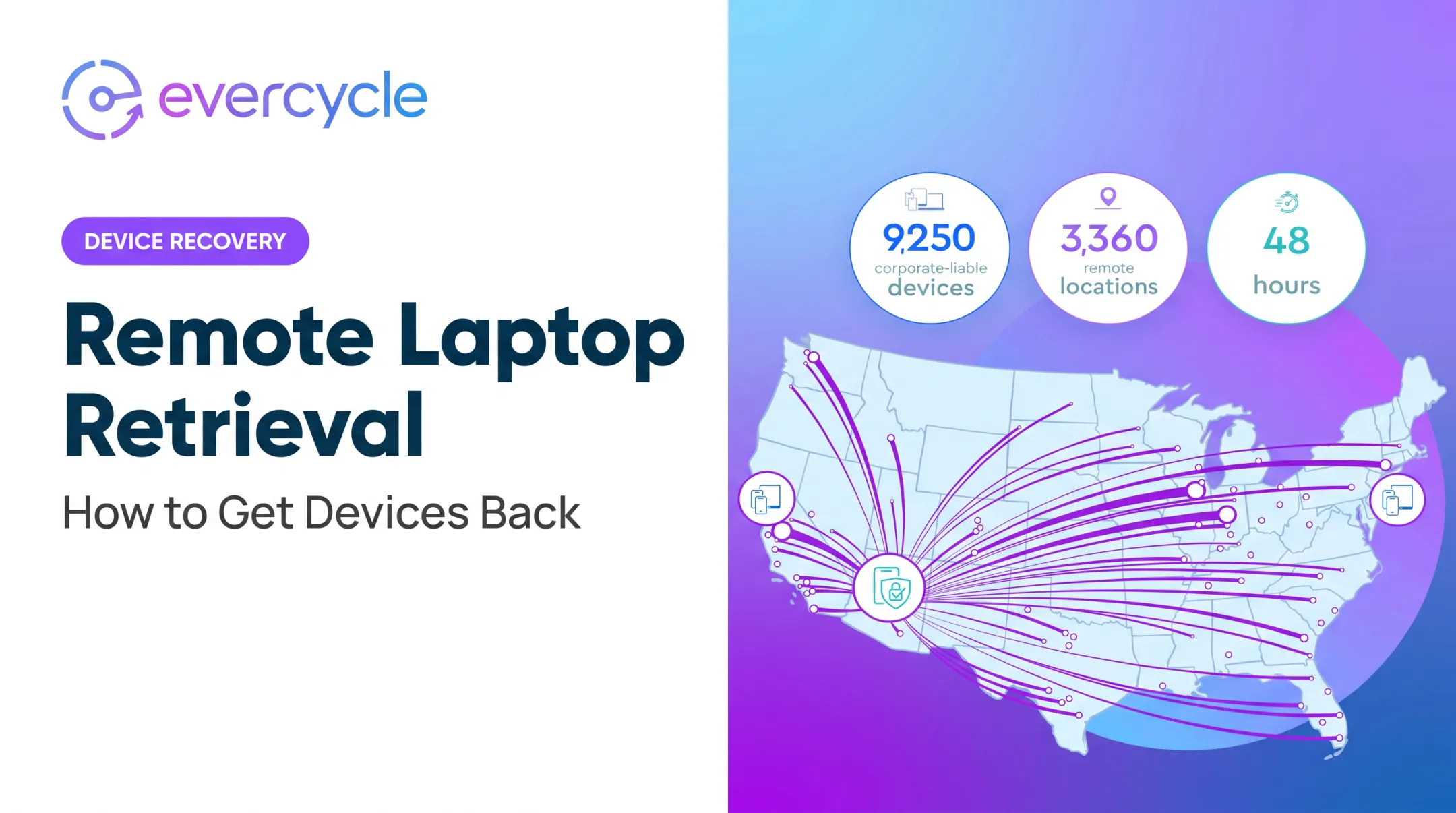
Reported results include a Fortune 500 recovery across 19 countries and 14 ITAD partners, plus 6,000+ return kits in transit within 48 hours of launch. Results vary by configuration and provider coverage.
When evaluating any platform, weigh integration depth, workflow flexibility, security controls, reporting, and partner coordination.
Frequently Asked Questions
What is returns management?
It is the process of authorizing, transporting, receiving, inspecting, routing, and closing returned products or assets. For IT, it applies to serialized devices and sits inside the broader reverse logistics program.
What does "reverse shipment" mean?
A reverse shipment moves a device from its user, site, or customer back to the organization or an approved repair, ITAD, resale, recycling, or disposal destination. Systems typically track it with return-from and return-to locations and status.
What are the 7 R's of reverse logistics?
The list varies by source. Acumatica names Return, Refurbish, Reuse, Repurpose, Resell, Recycle, and Responsibly dispose. BEUMER lists Returns, Recalls, Repairs, Repackaging, Recycling, Reselling, and Replacement. Both map to IT repair, reuse, resale, and recycling.
What is reverse logistics?
It is the managed flow of products, assets, and materials backward through the supply chain for return, repair, reuse, recovery, recycling, or disposal.
What is an example of reverse logistics?
A remote employee returns a laptop at offboarding. The organization verifies identity, tracks custody, sanitizes the drive, grades condition, then redeploys, repairs, resells, or recycles it.
Which software is commonly used in logistics?
Organizations combine transportation management, warehouse and inventory tools, ITSM, asset management, ERP, and ITAD or lifecycle orchestration software. Choose tools that integrate asset records, vendors, workflows, and audit evidence.