IT asset disposition (ITAD) is the secure, accountable, and environmentally responsible process for retiring unwanted IT assets through reuse, refurbishment, resale, recycling, or destruction. Done well, it protects data and recovers value. Done badly, it leaves missing devices and no paper trail.
This guide covers what ITAD includes, how the process works, why it matters for security and compliance, and how to build a repeatable program.
Key Takeaways
- ITAD covers the whole retirement workflow, from inventory and authorization to sanitization, disposition, and reporting.
- A sound program protects data while extending hardware life and recovering value where possible.
- Treat disposition as the end-of-life phase of IT asset lifecycle management.
- Evaluate both the physical ITAD provider and the systems that coordinate vendors and evidence.
What Is IT Asset Disposition (ITAD)?
ITAD is the controlled end-of-life management of IT equipment. A complete program combines physical handling, data protection, environmental responsibility, value recovery, and documentation. Landfill dumping or deleting a row from an asset register does not meet that standard.
ITAD versus IT asset disposal
"Disposal" is the narrower term. It usually means getting rid of equipment or destroying data. "Disposition" adds the decision: should this asset be redeployed, refurbished, resold, recycled, or destroyed?
That broader view lowers risk and improves lifecycle economics. It does not promise that every retired asset earns revenue. Some devices are worth little, and some must be destroyed regardless of value.
ITAD versus ITAM and lifecycle management
IAITAM describes ITAD as a component of ITAM that focuses on assets leaving the production environment. IT asset management (ITAM) tracks ownership, location, configuration, cost, and status across the whole life of an asset. ITAD is the retirement phase.
Lifecycle management links the stages so nothing vanishes between systems or vendors:
- Purchase and deployment
- Repair and support
- Employee transfer or offboarding
- Retrieval
- Disposition
- Final record closure
What IT Assets Are Covered by ITAD?
Common categories include:
- Laptops, desktops, workstations, and monitors
- Phones and tablets
- Printers and peripherals
- Servers, storage media, and networking gear
- Field and IoT hardware such as kiosks, scanners, and sensors
Data-bearing assets need the most attention. Files, credentials, cached information, configurations, and regulated data can survive long after a device leaves service. Accessories like cables and keyboards hold no data but still need responsible handling at end of life.
What shapes the disposition path
Five factors usually decide where an asset goes:
- Condition and age
- Media type
- Data sensitivity
- Ownership, including leases
- Business need
A two-year-old laptop in good shape may be redeployed or refurbished. A server with regulated data on failing drives may go straight to destruction.
How Does ITAD Work?
ITAD is a controlled sequence. It starts before equipment leaves a department, employee, office, or data center. It ends only when the asset's status, data treatment, and final destination are documented.

Asset identification and retirement authorization
Before collection, reconcile inventory and confirm serial or asset identifiers. Then check:
- Ownership, lease, and warranty obligations
- Legal holds
- Data classification
- Retirement approvals
Name the stakeholders early: IT, information security, procurement, finance, compliance, facilities, and HR or People Ops for remote-device recovery.
Secure collection, logistics, and chain of custody
Package, collect, transport, and receive assets through controlled handoffs. Tracking should record who had custody, when the transfer happened, and where the device went.
Distributed workforces and multi-vendor setups add pressure. You need:
- Clear employee communications
- Shipping workflows
- Exception handling
- Escalation for missing or damaged equipment
Data sanitization or destruction
NIST SP 800-88 Rev. 2, published in September 2025, replaced Rev. 1 and defines three methods:
| Method | What it does |
|---|---|
| Clear | Logical techniques that defeat simple, non-invasive recovery |
| Purge | Makes recovery infeasible with laboratory techniques, while the media can stay reusable |
| Destroy | Makes recovery infeasible and renders the media unusable |

No method fits everything. Match it to the storage technology, data sensitivity, asset condition, and intended next use.
Inspection and disposition decision
Testing, grading, and repair determine the route:
- Internal redeployment
- Refurbishment
- Resale
- Donation
- Recycling
- Destruction
Reuse and refurbishment generally preserve more value than immediate destruction. Security, contract, regulatory, or technical requirements can override that preference.
Recycling and downstream processing
Equipment that cannot be reused should go through responsible recycling and material recovery, including proper handling of hazardous components.
The EPA recognizes R2 and e-Stewards as the two accredited US certification standards for electronics recyclers. Ask for certification documentation and downstream vendor details, not vague "eco-friendly" claims.
Reporting, reconciliation, and closeout
A mature program produces:
- Asset-level status
- Sanitization results
- Certificates of destruction where applicable
- Resale or recycling outcomes
- Custody events and exceptions
- Final reconciliation against the original inventory
Why Is ITAD Important?
ITAD is risk management and lifecycle governance. It touches cybersecurity, compliance, operating costs, sustainability, and accountability.
Data security and privacy
Retired devices can hold customer information, employee records, credentials, intellectual property, and configuration data. Ordinary deletion or formatting does not reliably remove it.
Morgan Stanley shows the cost of weak tracking. The company decommissioned 500 devices in 2019, then could not locate 42 of them, which potentially held unencrypted customer data.
The SEC cited missing destruction certificates and chain-of-custody records, and imposed a $35M penalty in 2022 for broader safeguarding and disposal failures. The penalty covered more than this one project, and the order does not say the devices were exploited.

Regulatory and contractual compliance
Obligations vary by data type, industry, contract, and state. They are not interchangeable:
- HIPAA requires procedures for final disposition of electronic protected health information and for removing it before media reuse (45 CFR 164.310(d)(2)).
- FACTA's Disposal Rule covers businesses that use consumer reports.
- GLBA's Safeguards Rule makes secure disposal part of a covered financial institution's security program.
- State e-waste laws differ. New York and New Jersey, for example, ban business disposal of covered electronics as solid waste.
Whatever applies to you, keep documented procedures, vendor oversight, and retained destruction records. Auditors and customers will ask for them.
Financial and operational value
Structured ITAD reduces coordination overhead, avoids needless storage, and supports reuse. Resale or refurbishment can recover value. Returns depend on condition, market demand, ownership terms, processing costs, and security requirements, so never budget on guaranteed revenue.
Sustainability and the circular economy
The Global E-waste Monitor 2024 reports 62 million metric tonnes of e-waste generated globally in 2022. That figure covers all categories, not only enterprise IT.
Fraunhofer UMSICHT's 2025 study found refurbished laptops produce about 31% lower greenhouse gas emissions than a conventional lifecycle. It does not compare refurbishment against recycling alone. The practical lesson: redeploy, repair, or refurbish first, and recycle what cannot be reused.

Auditability across distributed environments
Spreadsheets, disconnected vendors, remote employees, and inconsistent handoffs create blind spots. The results are lost equipment, missing sanitization evidence, and inaccurate asset records.
Centralized workflow status, automated communications, chain-of-custody events, and exception reporting close those gaps. They matter most for enterprises and mid-market teams managing distributed fleets.
How to Build and Evaluate an ITAD Program
A durable ITAD program rests on clear policy, vetted partners, and connected workflows. Start with a written policy covering:
- Retirement triggers and approval authority
- Data-sanitization requirements
- Disposition priorities
- Custody controls
- Environmental expectations
- Documentation and exceptions
- Ownership across departments
Vendor and service-provider evaluation
Use this checklist when comparing providers:
- Relevant certifications or memberships
- Documented sanitization methods
- Chain-of-custody controls
- Downstream processor transparency
- Environmental practices
- Insurance and geographic coverage
- Scalability and references
- Service-level terms, pricing, and value-recovery terms
Know what each certification covers:
- R2v3: environmental, health, and safety controls and downstream tracking; Appendix B adds enhanced data-sanitization requirements
- e-Stewards: environmental protection and downstream vetting, with NAID AAA among its prerequisites
- NAID AAA: secure information destruction, including unannounced audits
Verify claims directly. Distinguish a certified physical processor from a software platform or logistics coordinator; they do different jobs.
Technology and workflow orchestration
ITAD workflows work best when connected to ITAM or CMDB records, HR offboarding, endpoint management, procurement, ticketing, shipping, finance, and provider systems. That cuts duplicate entry and missed handoffs.
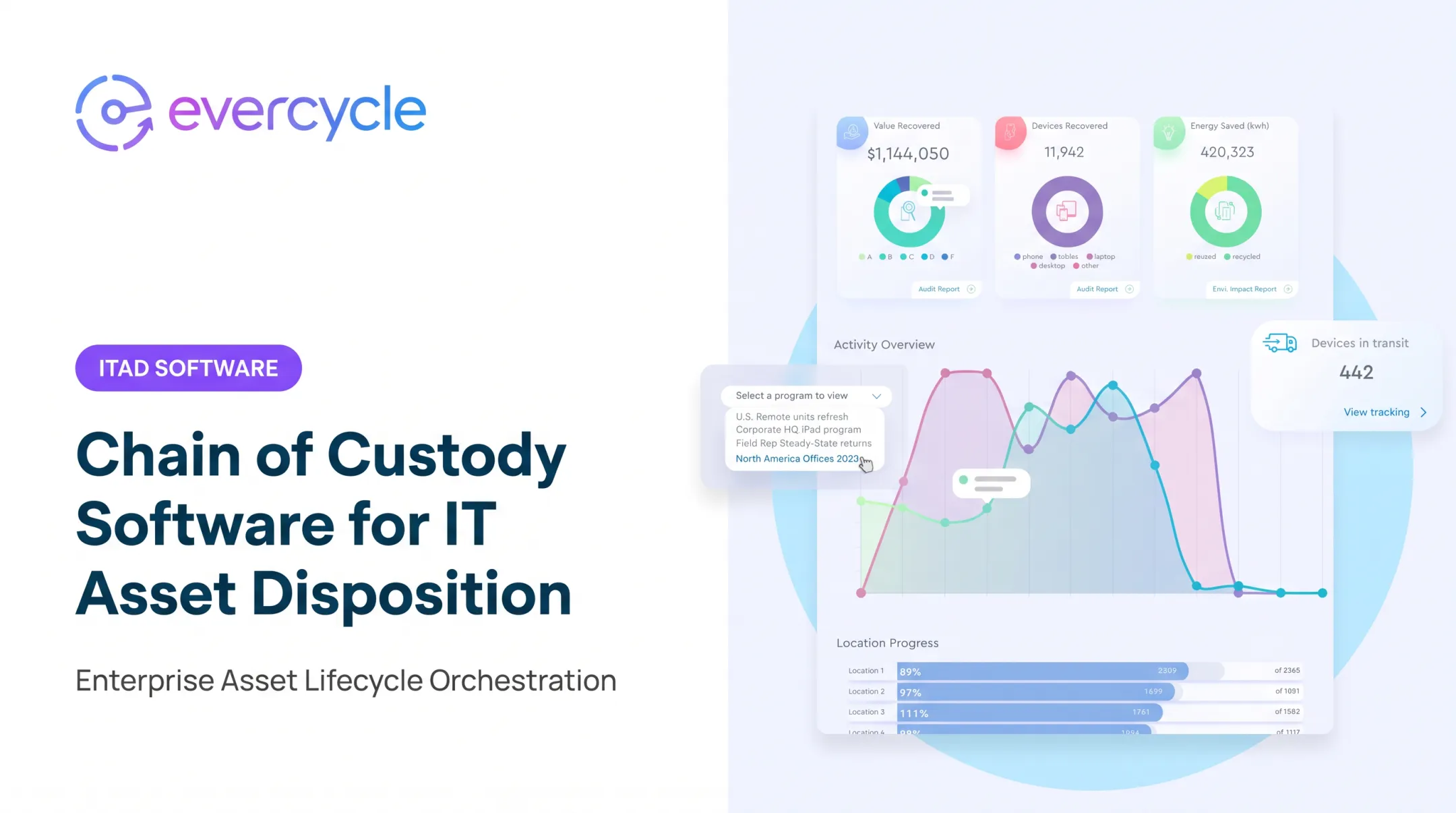
Evercycle is one example: an enterprise orchestration platform that works across existing vendors and systems. It automates routing and communications and gives lifecycle, chain-of-custody, and audit visibility. It coordinates workflows; it does not physically sanitize, ship, or recycle devices. Your certified providers do that.

Frequently Asked Questions
How does ITAD work?
ITAD runs from inventory and authorization through secure collection, data sanitization, and a disposition decision. Devices are then reused or recycled, and final documentation closes the record.
What do ITAD companies do?
They handle logistics, data sanitization or destruction, testing, refurbishment, resale, and recycling. They also report results and coordinate with the customer's internal teams.
What is IT asset lifecycle management and how does it work?
IT asset lifecycle management tracks assets from procurement and deployment through support, recovery, disposition, and record closure. ITAD is the end-of-life phase.
What is data disposal?
Data disposal is the secure removal or destruction of information from storage media. Verified sanitization differs from ordinary deletion or formatting, which can leave data recoverable.
What does IT asset disposition (ITAD) mean?
ITAD means retiring IT equipment securely and accountably through reuse, resale, recycling, or destruction. The goals are data security, environmental responsibility, documentation, and value recovery.
What is the correct way to dispose of old computers?
Inventory the computer and back up any data you must keep. Use a verified sanitization method suited to the drive, document the result, and send the equipment for reuse or recycling through a qualified provider.