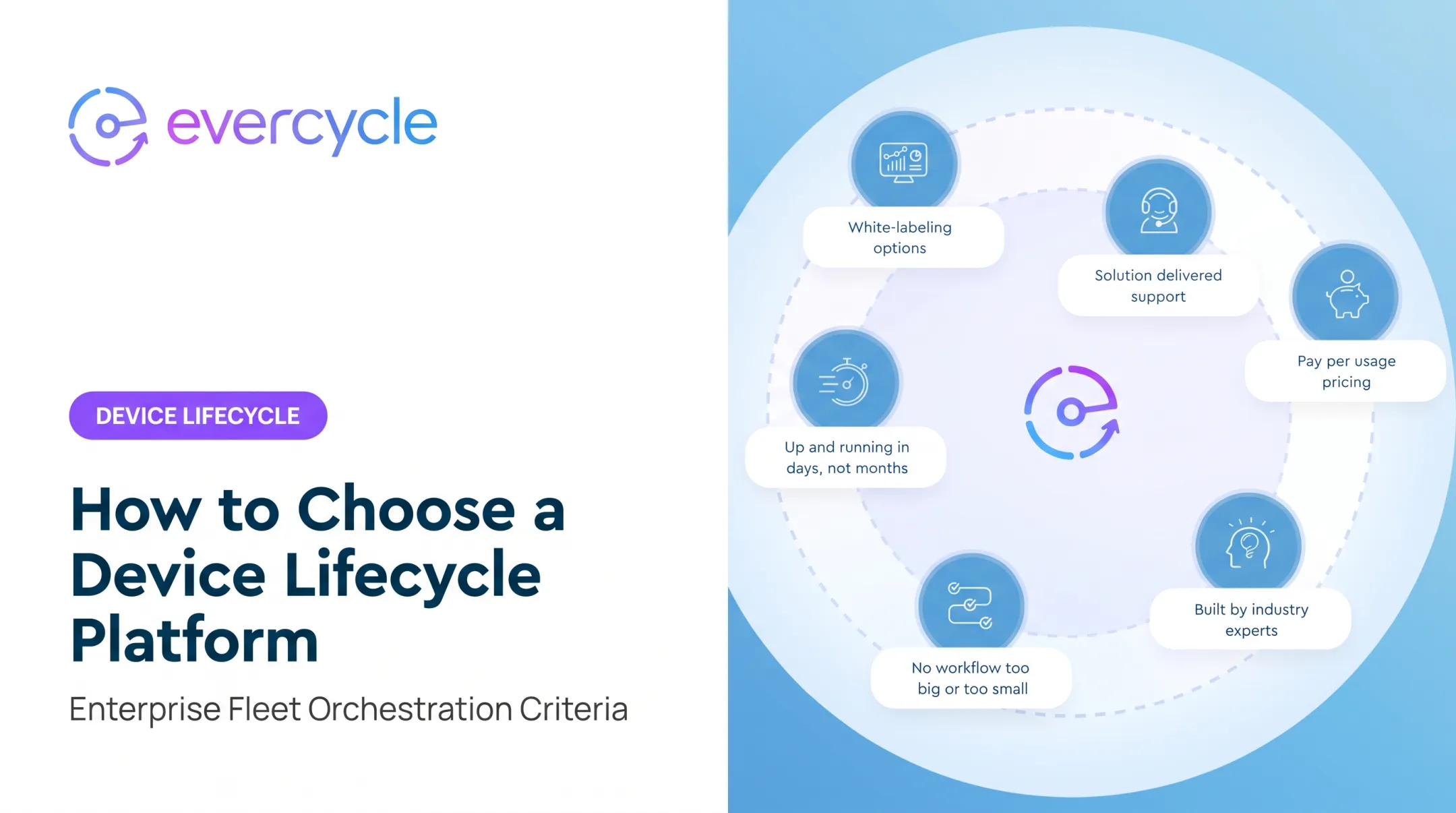
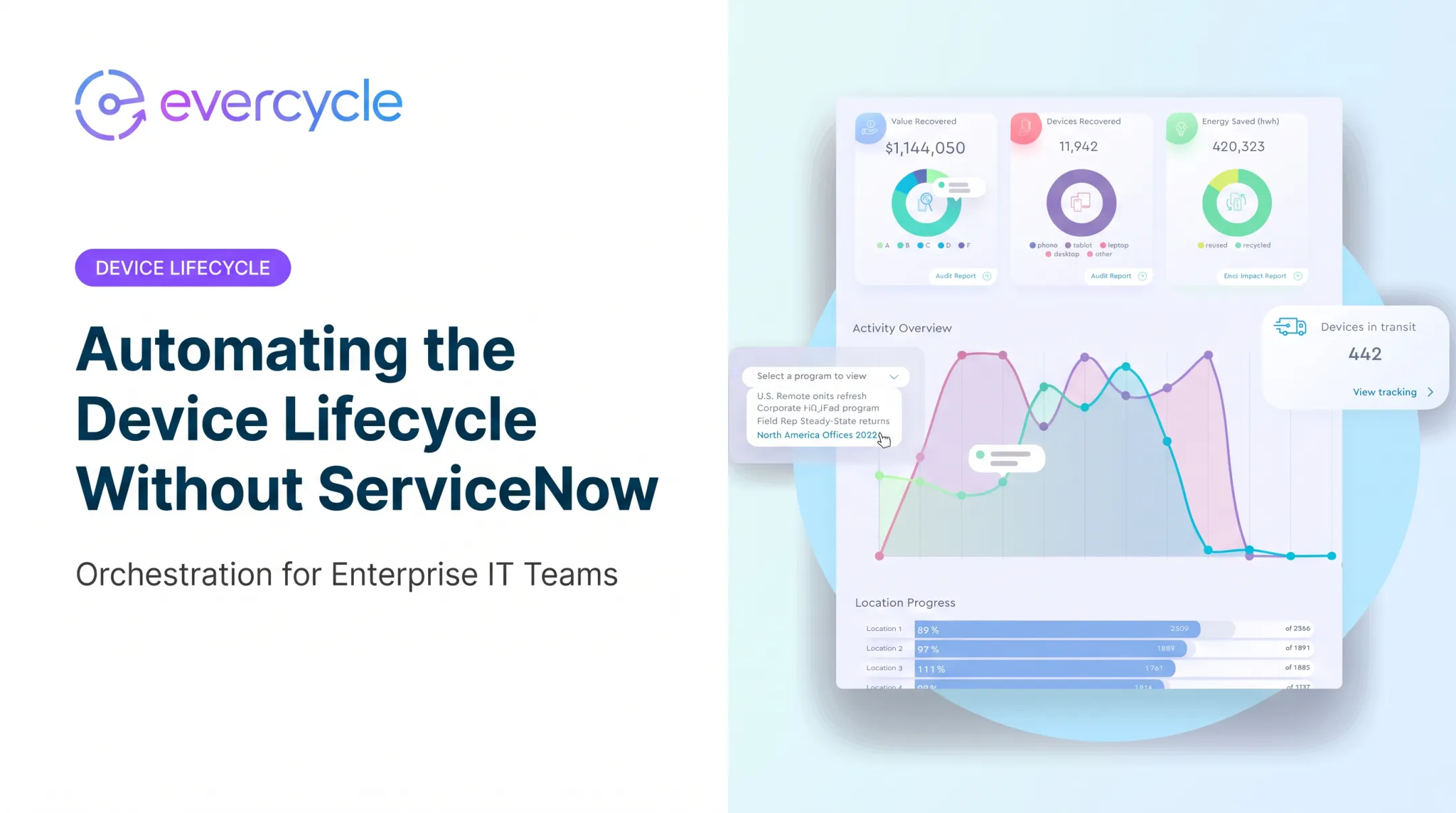
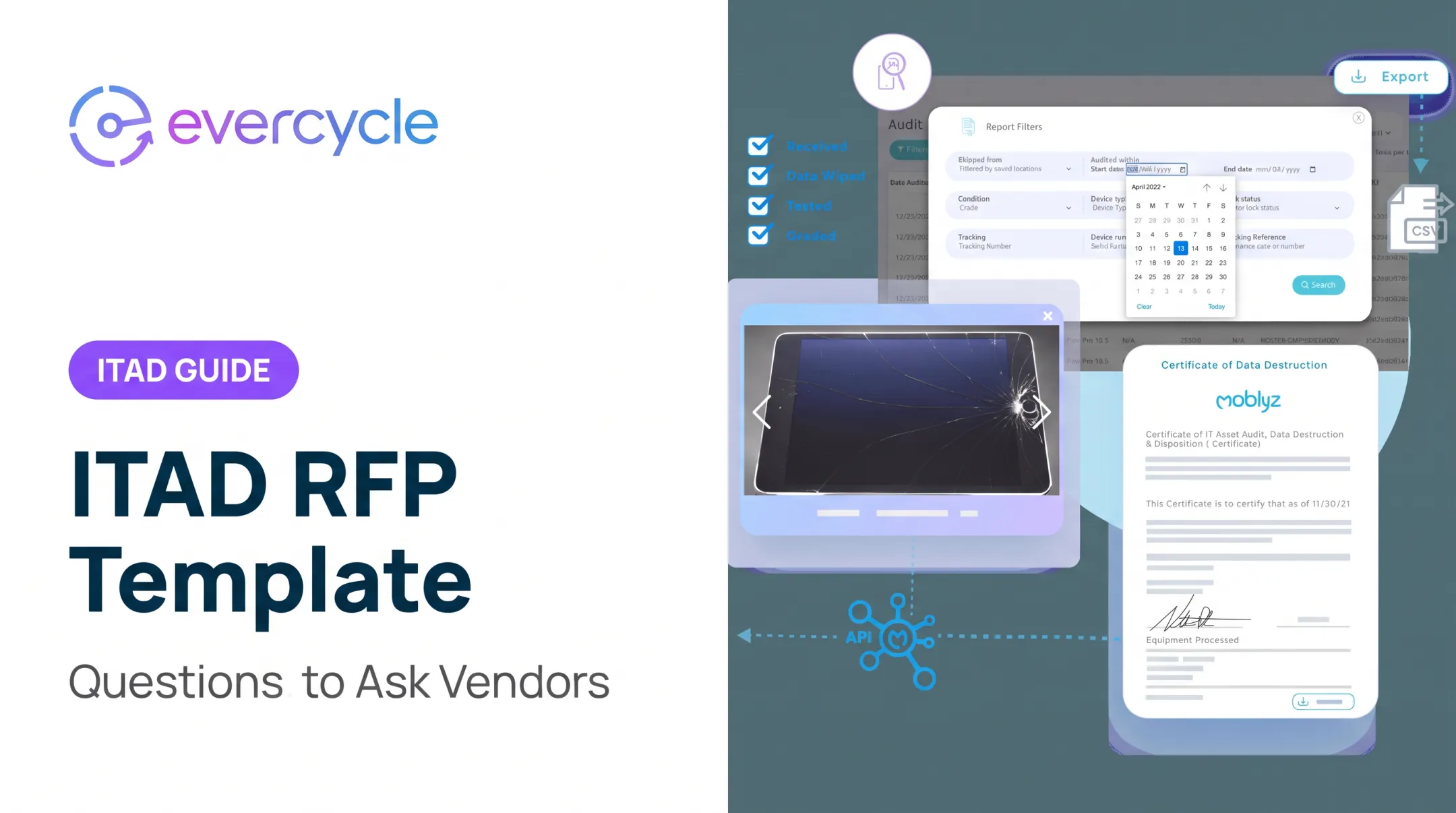
This guide covers software platforms that orchestrate device lifecycle activity. It is not about MDM tools or the providers that physically ship, repair or recycle equipment. Below you'll find the RFP questions, evidence standards and evaluation steps that separate real orchestration from a feature checklist.
Key Takeaways
- Separate lifecycle orchestration software from logistics, ITAD and endpoint management before comparing vendors.
- Ask how the platform handles events, handoffs, exceptions, communications and custody evidence.
- Make vendors demonstrate workflows, integrations and security controls rather than promise them.
- Score every response against the same use cases, implementation needs and total cost.
Before Writing the RFP: Define Scope, Ownership and Success Criteria
Define what the platform must manage
Map the lifecycle stages you need to cover:
- Procurement or receipt
- Deployment
- Assignment
- Transfer
- Repair
- Retrieval
- Reuse
- Disposition
- Recycling
For each stage, state whether the platform must execute, coordinate or simply record the activity.
Then name the system of record for each data type:
- Asset identity, serial numbers and IMEI numbers
- Ownership, location and lifecycle status
- Custody events
- Disposition documentation
Keep the definitions clean. Orchestration is the workflow layer that coordinates triggers, handoffs and records across existing systems and vendors. It is not ITAM inventory, and it is not MDM or UEM endpoint administration.
Identify stakeholders and scenarios
Document who initiates, approves and receives updates at each step: IT asset teams, HR and People Ops, employees, security, finance, procurement, MSPs, logistics providers, and ITAD partners.
Put representative scenarios in the RFP itself:
- Remote employee offboarding
- Lost equipment
- Repair or replacement
- Bulk refresh
- Employee transfer
- End-of-life disposition
Convert pain points into measurable requirements
Name the outcomes you want:
- Fewer manual handoffs
- Faster recovery
- Stronger traceability
- Fewer unresolved exceptions
- More reuse
- Easier audit prep
Ask each vendor how it would measure each one.
Also require every vendor to label each capability as one of these:
- Native
- Configurable
- Dependent on an integration
- Delivered by a partner
- On the roadmap
That single column in your response template exposes more than any demo.
Device Lifecycle Platform Capabilities: RFP Questions About Workflows and Automation
Asset records and lifecycle coverage
Ask: "What asset types, identifiers and relationships can the platform manage?" Require answers for laptops, mobile devices, peripherals and, where relevant, IoT or connected hardware. Cover at least:
- Serial numbers and IMEI data
- Ownership, location and assignment history
- Status changes across the lifecycle
Also ask how the platform keeps a full record from deployment through disposition, handles bulk imports, prevents duplicates, and links devices to employees, locations, tickets, orders and contracts.
Event-driven workflow automation
Ask what can trigger a workflow:
- HR events
- Procurement events
- ITSM tickets
- MDM or endpoint signals
- Scheduled dates
- API calls
- Manual actions
Can administrators configure triggers without custom development? Have vendors walk through conditional logic, approvals, escalations, reminders, SLA timers, exception queues and audit logs in a live workflow, not slides.
For context on scale, a ServiceNow case study describes Wipro automating 50% of previously manual asset tasks across roughly 600,000 assets. That figure is one customer's result, not a benchmark, so ask vendors for comparable evidence from their own deployments.

Vendor routing and partner coordination
Ask how work gets assigned to logistics, repair, refurbishment, recycling, MSP or ITAD providers by geography, device type, service level, capacity or policy.
Then ask how work orders, tracking events, proof of receipt, repair updates and exceptions move between platform and provider, and how you can audit unresolved handoffs.
Employee communications and self-service
Ask whether the platform sends return instructions, reminders, shipping details and escalation notices automatically, with different policies for employees, contractors, executives and remote workers.
Can employees confirm receipt, report a problem or schedule a return without opening an IT ticket? Are those acknowledgments kept as evidence?
AI and human oversight
Ask which functions use AI, such as routing, classification, exception detection or communications. Administrators should be able to review, override and explain automated decisions. The NIST AI RMF calls for documented human oversight and testing before and during operation. Request AI use cases, override points, decision logs, and how customer data is used to improve models.
Integrations, Data, Visibility and Reporting: Questions to Ask
Integration architecture
Ask which prebuilt connectors, APIs, webhooks and file-based options exist for HRIS, ITAM or CMDB, ITSM, MDM, procurement, ERP, identity, shipping and ITAD systems. Then press for detail:
- Authentication methods
- Sync frequency
- Supported objects and events
- Error handling and retry logic
- Rate limits and monitoring
- Who maintains each integration
Treat a vendor's connector list as a claim to verify. Ask for webhook documentation covering events, authentication, retries and versioning.
Data migration, ownership and portability
Ask how legacy records are imported, deduplicated and mapped, and how conflicts between systems get reconciled. Cover ownership and exit terms as well:
- Who owns the data
- What export formats are available
- What happens at contract end
- Whether documented schemas and migration help are included
Exit planning guidance such as Australian Government guidance recommends open, reusable export formats and documented exit costs. Use it as a practical checklist for your RFP.
Real-time visibility and exceptions
For every device, users should see:
- Current owner, location and status
- Assigned provider and shipment or repair stage
- Overdue action, exception reason and next step
Ask whether dashboards separate normal progress from stalled or failed events, route them to the right owner, and show age and resolution history.
Chain of custody and disposition evidence
Ask how the platform records custody changes, pickups, receipts, shipping references, repair outcomes, sanitization evidence and final disposition.
A platform usually captures documentation from physical providers rather than sanitizing anything itself. Ask how certificates and validation records get linked to the correct asset.
NIST SP 800-88 Rev. 2 calls for a Certificate of Sanitization for each sanitized media item, and SERI's R2v3 interpretation expects records per unique identifier. Require device identifier, method, result and verification for each.
Reporting and access controls
Ask which standard reports cover recovery performance, asset status, provider activity, repair, reuse, recycling, disposition value, exceptions and audit readiness. Then confirm:
- Filters by business unit, provider, location, employee type or asset class
- Whether nontechnical users can build, schedule and export reports
- How role-based controls protect sensitive employee, financial and vendor data
Security, Compliance, Implementation and Commercial RFP Questions
Data security and privacy
Ask about:
- Encryption in transit and at rest
- SSO, MFA and identity federation
- Role-based permissions and tenant isolation
- Privileged access, backups and disaster recovery
- Logging and monitoring
Also request current security documentation covering:
- Penetration-testing practices and vulnerability management
- Incident-response commitments
- Subprocessors, retention rules, and deletion or return processes
Ask for the actual SOC 2 Type II report, including its period, scope and exceptions, not just a badge. ISO/IEC 27001 is optional, so confirm whether the vendor holds it.
Compliance and audit evidence
Ask which security, privacy and data-destruction requirements the platform supports and how conformance is documented.
Make the vendor separate its own controls from certifications held by downstream partners such as R2, e-Stewards or NAID AAA. Then ask how partner credentials and audit rights are verified and kept current. Credentials lapse; TERRA, for example, has announced it ceased operations, so confirm status before you rely on it.
The stakes are real. In a 2023 Connecticut AG settlement, Morgan Stanley agreed to pay $6.5 million after decommissioned equipment went missing or was sold with customer data.
Implementation and support
Ask for an implementation plan that covers:
- Discovery, process design and integrations
- Migration, workflow configuration and testing
- User acceptance, training, launch and post-launch tuning
Then clarify who owns each activity, how configuration changes are governed, what support channels and response times are included, and how customer-specific workflows stay maintainable instead of turning into custom code.

Scalability and continuity
Ask how the platform scales across users, assets, vendors, locations and concurrent workflows, and request references with comparable complexity.
Cover uptime commitments, maintenance windows, status communication, DR testing and what happens during a major provider or integration outage. Read the SLA fine print: Gartner notes SLAs often cover uptime and ticket response while skipping recovery, remedies and termination rights, and some exclude API calls from credits.
Pricing and contracts
Require itemized pricing by unit (users, assets, transactions, workflows, providers or locations) plus implementation, configuration, API, support, storage, training and overage fees. Ask about:
- Contract length and renewal terms
- Price-increase caps (Gartner reports SaaS renewal increases often run 10% to 20% or more)
- SLA remedies
- Data export and termination assistance
- Ownership of configurations
- Costs to add providers or use cases

Conclusion and Next Steps: Turn Vendor Answers Into a Defensible Decision
Build a consistent scorecard
Score every vendor on the same categories:
- Lifecycle coverage
- Workflow automation
- Integration depth
- Visibility
- Security
- Compliance evidence
- Implementation
- Support
- Scalability
- Total cost
A U.S. Department of Education guide shows one sample split that gives demonstrations 35% and references 5%, and notes weights vary.
Require each major claim to be backed by a live demo, documentation, a reference or a clearly labeled commitment. Involve IT, security, HR, procurement, finance and operations.
Run scenario-based demonstrations
Give finalists identical scripts:
- Remote offboarding
- Repair exchange
- Failed return
- Multi-provider disposition
- Audit request
Make them show triggers, approvals, communications, handoffs, exceptions, reporting and evidence.
Then break it. What happens when data is incomplete, a provider misses an event or an employee never responds? Edge cases reveal more than a product tour.

Watch for red flags and pick the right category
Treat these as material risks:
- Vague integration claims
- Requirements that depend on the roadmap
- Unclear data ownership
- Unsupported AI promises
- No partner oversight
- No chain-of-custody evidence
Evercycle is an orchestration platform, not a hauler or ITAD processor. It unifies recovery, repair, disposition, vendor coordination and audit visibility across your existing providers and systems. That includes REST API and webhooks, connectors for tools such as ServiceNow, Jamf and Intune, and certificates of data destruction in audit reporting.
Judge it, and every other bidder, by the same scorecard.
Frequently Asked Questions
What is a device lifecycle platform?
It coordinates device activity from deployment through recovery, repair, reuse and disposition. It does this by connecting asset data, workflows, employees, vendors and reporting systems.
What is the difference between device lifecycle software and ITAD services?
Software orchestrates workflows and provides visibility. ITAD providers do the physical work: collection, sanitization, refurbishment, recycling and resale.
Which integrations should a device lifecycle platform support?
Look for HRIS, ITAM or CMDB, ITSM, MDM and endpoint tools, procurement or ERP, identity platforms, shipping carriers and ITAD partners. Verify each with documentation or a live demo.
What security and compliance questions should an RFP include?
Cover encryption, access controls, SSO and MFA, audit logs, incident response, retention, subprocessors and security reports. Separate the platform's own controls from partner certifications.
How should we evaluate device lifecycle platform vendors?
Use a common scorecard, scripted scenario demos, evidence-backed answers, cross-functional review, reference checks and a total-cost analysis.
Can a device lifecycle platform work with existing logistics and ITAD providers?
It should. Test vendor routing, APIs, work-order exchange, event tracking and exception handling, and confirm you keep visibility across every provider you already use.