Tangoe's 2026 report describes 2-3 devices per worker plus multiple SIMs as the new normal. That volume strains any team running lifecycle work by spreadsheet.
Managed Mobility Services (MMS) and device orchestration both tighten lifecycle control. They answer different questions, though. MMS asks who should operate the program. Orchestration asks how to coordinate the people, systems, and providers you already have.
This article compares them on scope, ownership, internal resources, vendor complexity, integrations, security, visibility, and total cost.
Key Takeaways
- MMS outsources some or all mobile program operations to an external provider.
- Device orchestration is a software layer coordinating workflows, vendors, and records.
- Choose MMS for execution capacity; choose orchestration for coordination and visibility.
- The two combine well: providers do the work, the platform coordinates and records it.
- Your desired operating model matters more than device count.
MMS vs Device Orchestration: Quick Comparison
| Factor | Managed Mobility Services | Device Orchestration |
|---|---|---|
| Operating model | Outsourced service with provider accountability | Software coordinating internal teams and providers |
| Scope | Procurement, provisioning, support, carrier and expense administration, repairs, recovery, retirement (per contract) | Event-driven workflows, routing, approvals, communications, vendor work orders, chain-of-custody records |
| Cost structure | Service fees, per-device charges, project and logistics costs | Software and implementation costs on top of existing provider and labor costs |
| Visibility | Depends on the provider's portal, reporting, and integrations | Shared view of assets, status, vendors, and next actions |
| Best fit | Teams lacking capacity or expertise | Teams with capable providers but fragmented coordination |

Cost: compare totals, not subscriptions
MMS pricing varies widely by vendor and scope. For a published example, vMOX advertises rates as low as $1.25 per device per month for financial and procurement management and $2.00 for endpoint managed services. Those are vendor-specific figures, not market averages.
Orchestration software sits alongside existing provider, logistics, ITAD, and internal labor costs. Evercycle's enterprise plans, for example, start at $550 per month for the parent account, with per-workflow and per-kit shipping fees added. Weigh total cost of ownership, including internal labor and exception handling, rather than subscription price alone.
What Are Managed Mobility Services (MMS)?
MMS is a broad, usually outsourced program for managing enterprise mobile devices and their operational, security, connectivity, support, financial, and lifecycle activities. The industry association ETMA defines it as procurement, deployment, and management of mobile devices, applications, and the services that connect out-of-office workers. Exact scope varies by provider and contract.
Core components to evaluate
- Sourcing, procurement, staging, and provisioning
- MDM or UEM administration
- Carrier and connectivity management
- Employee help desk, repairs, and replacements
- Inventory and expense governance
- Device recovery, secure data erasure, recycling, and disposition
Outcomes and trade-offs
Done well, MMS reduces internal workload, applies security controls consistently, and gives better cost visibility. Tangoe reports that Rich Products' annual mobility spend fell more than 16% over four years across a 2,600-device program. That is a provider-published result with no stated starting baseline.

Outsourcing brings specialist staff and a single point of accountability. It can also mean less direct control, provider dependency, and data that stays fragmented if the MMS portal isn't integrated with your enterprise systems. Verify service boundaries and SLAs before signing.
Use Cases of Managed Mobility Services
MMS covers the lifecycle from ordering and configuration through onboarding, support, repair or replacement, offboarding, recovery, secure retirement, and cost reconciliation.
It tends to suit organizations with:
- Multiple carriers and complex device mixes
- Remote or frontline workforces
- Regulated data environments
- High employee turnover
- Limited internal mobility expertise
Expense-heavy fleets show the clearest published results. GoExceed reports that an anonymous transportation company with 9,028 connected devices cut a $139,000 monthly bill by $63,000 in the first billing cycle after a usage audit and plan realignment.
That result is vendor-reported and covers connected-device SIMs, not employee handset lifecycles, so treat it as a connectivity-cost example rather than a full MMS outcome.
What Is Device Orchestration?
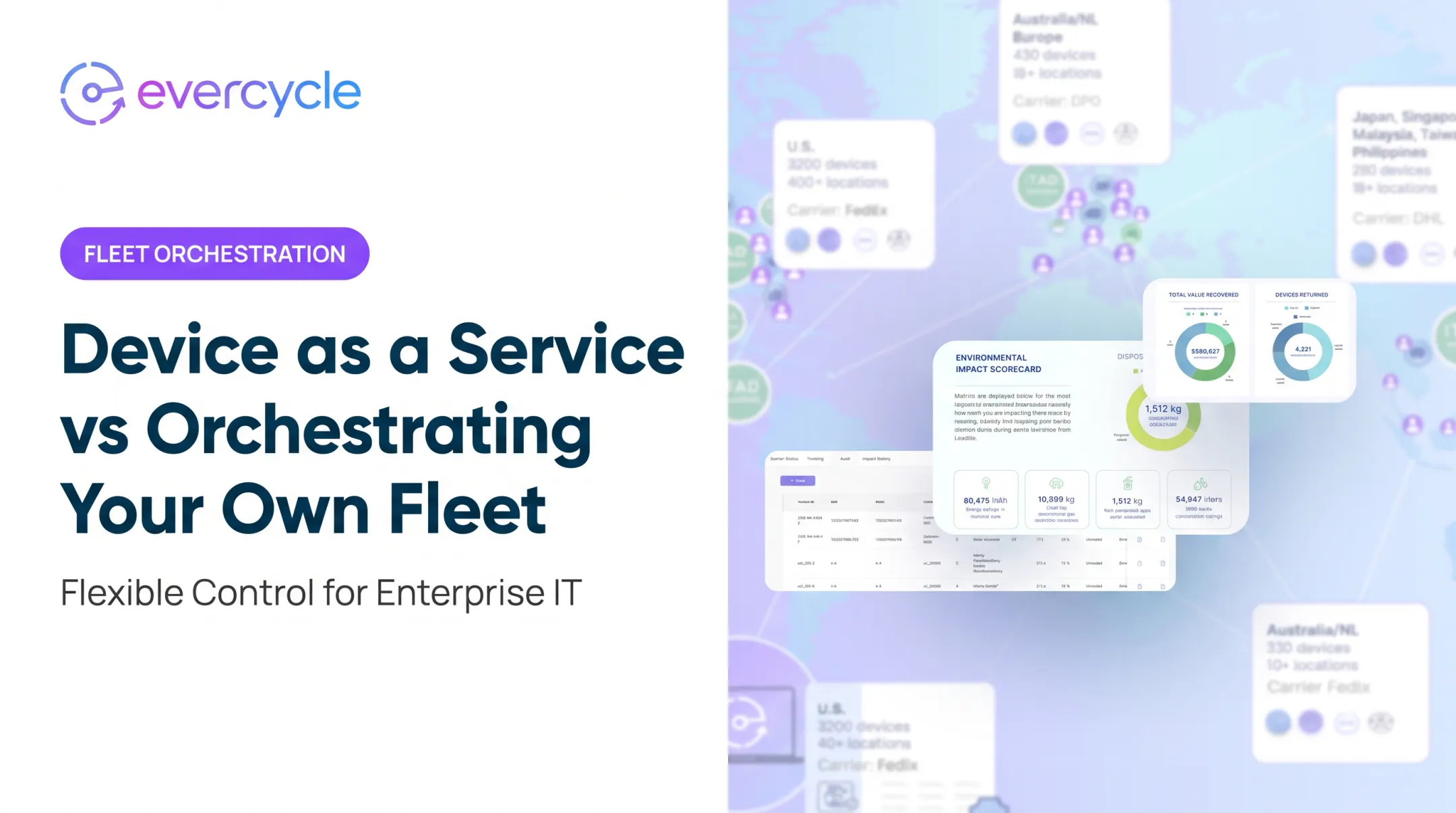
Device orchestration is a software coordination layer that turns lifecycle events into repeatable actions across asset records, HR systems, ITSM, procurement, logistics, repair, MDM or UEM, and ITAD providers. No formal analyst definition exists yet, and vendors use the term differently.
How an event-driven workflow runs
- A new hire triggers device assignment and provisioning.
- A departure triggers return instructions and logistics.
- A recovered device triggers inspection, then redeployment, repair, resale, or disposition.

For example, when an HR system records an employee's last day, Evercycle's workflow sends return instructions, arranges logistics, tracks progress, and routes the outcome.
Why it matters
Benefits include:
- Fewer manual handoffs between teams and vendors
- Automated vendor routing and real-time status
- Chain-of-custody records and faster exception handling
- Stronger audit readiness across the lifecycle
The exposure is real: a YouGov survey of 213 senior IT professionals found 49% lost at least 5% of technology assets when workers left. It's a self-reported 2022 survey, so treat it as directional.
How it differs from MDM, UEM, and MMS
- MDM or UEM manages device policies and configurations.
- MMS supplies managed operational services.
- Orchestration coordinates actions and information across those systems, teams, and providers.
The boundaries
Orchestration software doesn't supply a warehouse, repair team, carrier contract, help desk, or ITAD operation. Connected partners do that.
Evercycle is an enterprise orchestration platform that works across existing vendors and systems. It covers deployment, retrieval, repair, disposition, vendor routing, employee communications, chain-of-custody tracking, and audit reporting. It isn't an MDM platform and doesn't physically process or ship hardware.
Use Cases of Device Orchestration
Orchestration fits situations where devices, vendors, and locations are spread out:
- Distributed employee fleets
- IoT and connected hardware
- Field equipment
- Remote onboarding and offboarding
- Multi-vendor ITAD programs
- Compliance-driven recovery
It's especially useful when you want to keep your existing MSPs, logistics companies, repair partners, and ITAD vendors but need one workflow and reporting layer across them.
A concrete example: a Shipping Manager in reverse logistics reported recovering over 740 devices from remote employees on the first day of a bulk-return program run on Evercycle. In another program, Evercycle reports tracking recovery of 9,250 devices from 3,360 remote locations in under 48 hours. Both are vendor-reported and results vary by configuration and provider coverage.

MMS vs Device Orchestration: What Is Better?
Neither option wins in every environment. Judge by these criteria:
- Desired level of outsourcing
- Internal IT capacity
- Need for carrier or help desk support
- Number and type of providers
- Existing integrations
- Security and compliance requirements
- Physical logistics coverage
- Reporting needs and total cost
Choose MMS when
You want a third party to operate large parts of the program: procurement, endpoint administration, support, expenses, repairs, and lifecycle services. Gartner's 2026 market guide notes that provider selection is challenging and advises aligning technical, commercial, and operational priorities.
Choose orchestration when
You already have internal teams or providers but need a unified workflow layer, automated routing, cross-system visibility, employee communications, and documented chain of custody.
Choose both when
You need outsourced execution plus independent coordination across several MMS, MSP, logistics, repair, or ITAD partners. Orchestration preserves provider flexibility while improving accountability and reporting.
Evaluation checklist
- Map the current lifecycle from request through disposition.
- Identify every handoff and system of record across teams and vendors.
- Document retained versus outsourced responsibilities.
- Calculate internal labor and exception costs.
- Test integrations with ITSM, MDM, and vendor systems.
- Review security controls against standards such as NIST SP 800-88 for media sanitization.
- Define measurable success criteria before selecting a platform or service.

Real-World Examples and Case Studies
Evercycle's published Fortune 500 telecom manufacturer program involved thousands of devices across multiple countries and 14 ITAD providers. The case study reports over 90% of targeted devices recovered, launch in under two weeks, and an 80% reduction in manual tracking and coordination labor. Device counts and labor baselines are not published with the results, and materials cite different country totals (22 versus 19), so confirm program scope before relying on those figures.
The pattern is clear: the providers already existed. The gap was coordination, handoffs, and evidence, which is where orchestration applies.
Takeaway by situation:
- Execution capacity is the main gap: lead with MMS.
- Coordination and visibility are the main gaps: lead with orchestration.
- Both gaps exist: combine them.
If you want to see how your current lifecycle workflows and provider network could be mapped without replacing every vendor, explore Evercycle's platform and request a demo.
Conclusion
MMS is an outsourced operating model. Device orchestration is a software coordination layer. Each addresses a different source of lifecycle complexity, so the right answer depends on where yours comes from.
Decide which responsibilities to outsource, which to keep internal, and where a shared orchestration layer would improve visibility, security, accountability, reuse, and audit readiness.
Frequently Asked Questions
What does "mobility services" mean?
Mobility services are the technologies, processes, and support activities used to manage business devices, connectivity, security, users, costs, and lifecycle events.
What are managed services?
Managed services are ongoing technology or operational functions delivered and monitored by an external provider under an agreed scope, service levels, and accountability.
What does EMM do?
Enterprise Mobility Management coordinates policies, applications, security, users, and mobile endpoints. It doesn't run physical lifecycle logistics the way MMS or orchestration workflows can.
Is EMM the same as MDM?
No. MDM is one EMM component focused on device administration and policy enforcement. EMM also covers applications, content, identity, and broader controls.
Should device management be turned on?
Yes for company-owned or business-critical devices where security, compliance, remote support, or inventory visibility matters. For BYOD, limit management to work apps and data, and set clear privacy policies.