Introduction: Why Enterprise ITAD Reporting Matters
Picture an audit request landing on your desk: show where 1,200 retired laptops went, how their drives were handled, and what the program recovered. The answers sit in spreadsheets, vendor portals, email threads, PDF certificates, and carrier records that don't match.
A report that only confirms pickup doesn't solve this. Enterprises need a record that proves where each asset went, how data was handled, what value came back, and which exceptions remain open.
The cost of getting this wrong is real. IBM's 2026 breach study puts the average US breach at $11.5M, though that figure covers breaches broadly, not disposal failures alone.
This article gives you a framework for judging ITAD reporting, from asset-level detail to stakeholder needs.
Key Takeaways
- Every asset should connect to a disposition outcome and its supporting evidence.
- Reports need executive summaries plus asset-level drill-downs.
- Custody events, sanitization proof, and exceptions must be easy to retrieve.
- Test workflows, integrations, permissions, exports, and data ownership before choosing a partner.
What Enterprises Need ITAD Reporting to Prove
The core accountability questions
A strong report answers five questions:
- Who handled the asset
- What happened to it
- When the work occurred
- Where it moved
- What evidence backs the final outcome
An activity summary says "400 devices processed in March." An auditable record ties each device from the original inventory to collection, transport, processing, and its final outcome: resale, reuse, recycling, or destruction.
A representative asset journey looks like this:
- Asset ID LT-20418 appears in the enterprise asset register as retired.
- A pickup request and shipment ID link to that ID.
- Scan events and receipt confirmation show custody transfers.
- A sanitization record lists method, date, and verification.
- A disposition record names the outcome and downstream party.
- The financial record and closure status complete the trail.
If a reviewer can follow those steps without emailing anyone, the report works.

Multiple stakeholders, one data set
Different teams ask different questions of the same data:
- Security reviews sanitization evidence and failed attempts.
- Finance reviews recovered value and settlement.
- Compliance reviews custody records and certificates.
- Sustainability reviews reuse and recycling outcomes.
- Executives review program-level trends and open exceptions.
One generic report rarely serves all of them. Role-based views over a single underlying data set give each group the right level of detail.
Exceptions must be visible
Missing assets, delayed pickups, incomplete certificates, failed sanitization, disputed quantities, and unconfirmed downstream outcomes should never vanish into aggregate totals.
Each exception needs these fields:
- Issue description
- Affected asset or shipment
- Owner
- Status
- Date identified
- Required next action
No public standard prescribes an ITAD exception taxonomy, so write the taxonomy you need into the contract.
Unresolved exceptions weaken audit readiness, leave security risk open, block financial reconciliation, and muddy service-level reviews. A device missing in transit can itself be treated as a data breach for which the organization is liable.
Historical accountability
Keep prior reports, amendments, supporting documents, and event timestamps. They let you reconstruct past activity during internal audits, regulatory inquiries, insurance reviews, vendor disputes, and site-level investigations.
Separate certification requirements from legal ones. e-Stewards guidance sets a five-year default minimum for required records, and i-SIGMA requires destruction agreements be kept three years. Both are certification-scope rules.
HIPAA's six-year documentation period covers required security policies and actions, not ITAD certificates as such. Confirm periods with counsel, including state rules, before you set a policy.
Reconciliation turns a report into a control
Reconcile ITAD data against the asset register, procurement records, endpoint management, shipping records, and provider records. NIST SP 800-53 calls for inventories that are current, complete, and accurate, which is why reconciliation belongs in the reporting program.
Report on unmatched assets, duplicate identifiers, quantity gaps, missing serial numbers, and records that can't be linked. Done well, reconciliation exposes process breakdowns and improves inventory accuracy, rather than producing a static document.
The Data Every Enterprise ITAD Report Should Contain
Asset identity and inventory context
Include these identity fields:
- Enterprise asset ID and serial number
- Manufacturer, model, and device type
- Configuration where relevant
- Source location, retirement date, and business unit
- Assigned user only where policy allows
Preserve your own identifiers. A provider ticket or shipment number alone breaks the link to your asset register. Mask or restrict employee and customer information according to your privacy and access policies.
Chain of custody and logistics
Capture these elements:
- Pickup requests and custody transfers
- Shipment or container IDs
- Origin, destination, and carrier or handler
- Scan events and receipt confirmation
- Processing location and date-time stamps
Tie shipment events to individual assets wherever operations allow, and flag batch-level limits plainly. Signatures, scans, and transfer acknowledgments strengthen the evidence. i-SIGMA's 2026 specifications require documented custody steps, dates, times, and the individuals involved.
Sanitization and destruction evidence
NIST SP 800-88 Rev. 2 (2025) supersedes Rev. 1. Its sample certificate includes manufacturer, model, serial number, asset number, media type, method, tool and version, verification method, and verifier details.
Your report should show:
- Status and method
- Completion date and operator reference
- Media identifier and result
- Certificate link
Separate these cases:
- Successful sanitization
- Failed or inconclusive attempts
- Physical destruction
- Assets received with no verifiable record
No single method suits every device. Degaussing, for example, doesn't work on flash or SSD media. The right evidence depends on media type, enterprise policy, risk profile, and the provider's process.
Final disposition and downstream outcomes
Name the real outcome: redeployment, reuse, refurbishment, resale, parts recovery, recycling, or destruction. "Recycled" or "processed" alone is too vague for audit purposes.
Add these disposition details:
- Disposition date
- Downstream processor
- Certificate reference
- Resale status
- Any pending action
e-Stewards requires an up-to-date downstream disposition chart with shipping acknowledgments, which shows the level of downstream detail serious programs keep.
Financial recovery and cost
Useful fields include:
- Assessed value and sale or credit amount
- Fees, logistics, and refurbishment costs
- Revenue share, invoice reference, and payment status
Distinguish estimated from realized value, and gross proceeds from net recovery.
Fields vary by contract. No standard format or recovery benchmark exists, so reconcile against invoices, credits, and settlement statements.
Sustainability and program metrics
Report units reused, refurbished, resold, recycled, or destroyed. Add material recovery or environmental indicators only with a documented method.
Any impact estimate should state its calculation method, source, boundary, and assumptions. EPA's WARM v16 documentation shows why: its electronics factors exclude upstream manufacturing and aren't an ITAD-specific avoided-emissions factor for reuse. Keep the underlying asset records so ESG claims trace back to operational evidence.

How Enterprise ITAD Reporting Should Work in Practice
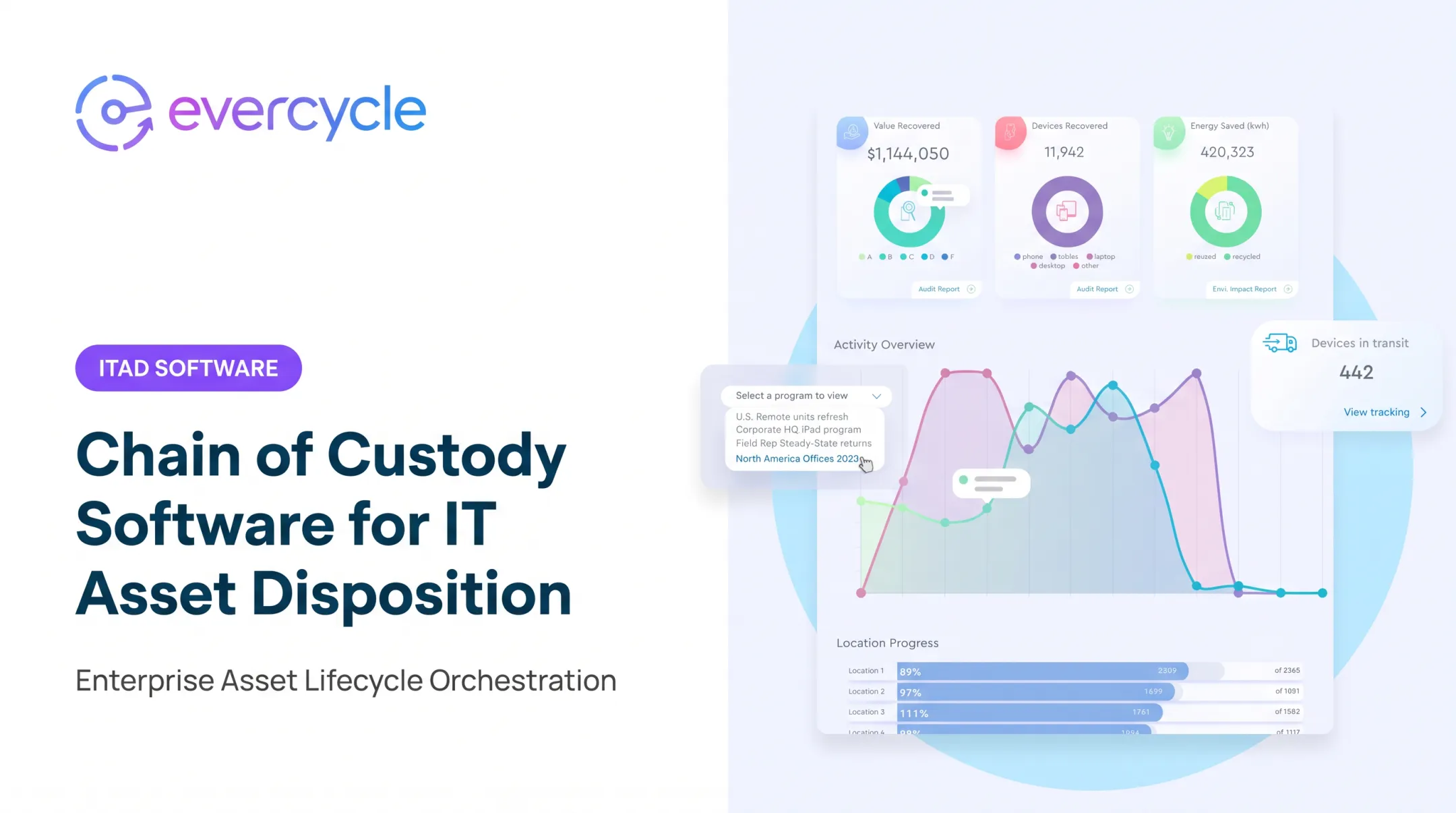
Executive summaries and asset-level drill-downs
The executive view shows:
- Total assets processed and completion status
- Disposition mix and recovery outcomes
- Open exceptions and security status
- Sustainability indicators
The detailed view holds asset identifiers, custody events, sanitization evidence, final disposition, financial records, and document links. Executives need trends and exceptions. Auditors and operations teams need searchable, exportable records.
Scheduled reporting and on-demand investigation
Align recurring reports to pickup cycles, monthly or quarterly reviews, financial settlements, audit schedules, and sustainability reporting periods.
On-demand filters should cover:
- Business unit, location, and device type
- Vendor, project, and date range
- Disposition, security status, and exception status
Also define the authoritative reporting time zone, data refresh timing, report generation date, and whether late provider records are backfilled.
Portable, secure, integration-ready
Delivery options include:
- Secure portals and downloadable files
- Controlled notifications and APIs
- Integrations with asset, service, endpoint, procurement, finance, and sustainability systems
Require role-based permissions, access logs, encryption, version control, and limits on exporting sensitive data. Ask whether exports keep asset-level relationships, document links, timestamps, status history, and field definitions.

No public cross-industry standard covers portals, APIs, or data ownership, so test these in the sample and contract.
Clear definitions and consistent status logic
Insist on a data dictionary that defines each status clearly:
- Collected, received, sanitized, processed
- Sold, recycled, destroyed, closed
- Pending and exception
Inconsistent definitions across vendors or regions make enterprise-wide reporting misleading. Document how batch records, partial completions, cancelled work orders, returned assets, and duplicates appear.
Platform reporting alongside provider evidence
An orchestration platform can unify workflow events, vendor updates, logistics data, and enterprise asset records. It doesn't replace certificates or records issued by the physical processor.
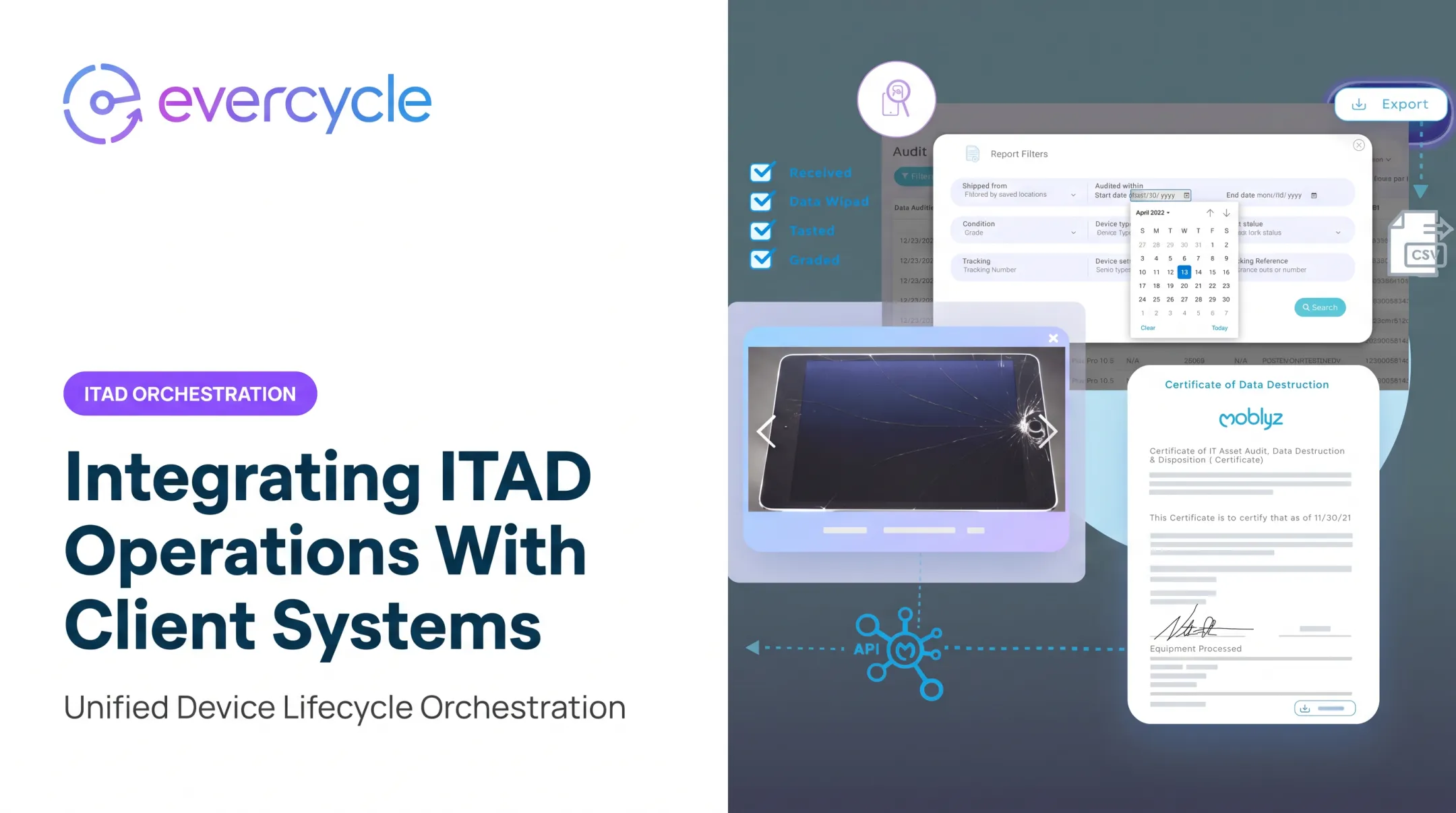
Evercycle is one example. It connects existing vendors and systems through event-driven workflows, chain-of-custody tracking, and audit reporting. Its audit reports can include device specifications, data-erasure results, and certificates of data destruction.
Evercycle doesn't physically destroy, recycle, resell, or ship equipment. The selected provider remains responsible for its own operational evidence.
Reporting Outcomes Across Security, Compliance, Sustainability, and Finance
Security and compliance
Complete reporting lets teams verify sanitization, spot gaps, investigate exceptions, and assemble evidence for reviews. Cite regulations only for what they actually require:
- HIPAA requires reasonable disposal safeguards and procedures, but no single method or certificate form.
- GLBA Safeguards Rule requires secure disposal of customer information within two years of last use, subject to exceptions.
- NIST SP 800-53 MP-6 calls for sanitizing media before disposal or reuse, with strength matched to sensitivity.
HHS documented a case where up to 344,579 people's health information was exposed after photocopier hard drives were returned without erasure. HHS cited missing risk analysis and disposal procedures.
Financial and operational outcomes
Consistent reporting can reveal:
- Delayed processing and uncollected equipment
- Avoidable logistics costs and missed resale opportunities
- Weak vendor performance
- Gaps between physical and recorded inventory
Those same records give service-level reviews and contract talks a factual base. Claim savings only when you've documented them.
Sustainability and executive outcomes
Disposition data supports reuse-first decisions, oversight of recycling partners, sustainability disclosures, and leadership reviews of circularity.
Any emissions estimate or diversion claim needs a credible source and an explained method. The GHG Protocol's Scope 3 guidance says avoided recycling emissions shouldn't be deducted from the inventory and may be reported separately with the boundaries disclosed.
How to Set ITAD Reporting Requirements Before Choosing a Partner
Build a requirements checklist
Write down your non-negotiables before you evaluate vendors:
- Required asset fields and custody events
- Certificates and disposition categories
- Financial, sustainability, and exception fields
- Report cadence and stakeholders
- Retention and integration needs
Then decide which records must be available at asset, shipment, project, business-unit, and enterprise level.
Test a sample report and its evidence
Request a realistic anonymized sample with completed assets, pending assets, exceptions, failed records, and document references. Then test:
- Can a reviewer trace one record from inventory through custody, sanitization, disposition, settlement, and closure?
- Do provider certificates and downstream records link back without manual searching?
- Do exports keep relationships, timestamps, and status history?

The evidence matters more than portal claims.
Ask about ownership and governance
Ask about:
- Data ownership and correction workflows
- Report versioning and access permissions
- Retention and incident escalation
- Provider changes and updates to data definitions
Also ask how the partner measures report completeness, resolves discrepancies, handles late records, and announces format changes.
Choose the partner or platform that makes evidence easy to retrieve, exceptions easy to manage, and reporting consistent across your existing vendors.
Frequently Asked Questions
What should be included in an ITAD report?
Asset identifiers, chain-of-custody events, sanitization evidence, final disposition, financial or sustainability outcomes, open exceptions, and links to supporting documents.
Why is chain of custody important in ITAD reporting?
It shows who handled an asset, when transfers occurred, and whether the asset stayed controlled through final disposition.
How often should an enterprise receive ITAD reports?
It depends on volume, contract terms, audit needs, and settlement cycles. Scheduled reports plus on-demand access usually work best.
What is a certificate of data destruction?
It is provider-issued evidence that a destruction or sanitization process was completed. Link it to the relevant asset or media identifier.
How can ITAD reports support audits and compliance?
Searchable asset histories, custody records, sanitization evidence, exception logs, and disposition documents help demonstrate control and answer auditor questions quickly.
Can ITAD reporting track resale, recycling, and sustainability outcomes?
Yes, when providers supply reliable asset-level or batch-level records and disclose the methods behind environmental or recovery metrics.