A downstream audit tests the whole path, from handoff to final disposition. A certificate or a logo on a website proves very little by itself.
This checklist covers five steps: define scope, review contracts and credentials, test controls, reconcile asset-level evidence, and track remediation.
Key Takeaways
- Follow sampled assets through intake, custody transfers, sanitization, reuse, recycling, or destruction.
- Validate certifications and certificates against records and observed practice.
- Contracts need audit rights, subcontractor visibility, incident notice, and evidence retention.
- Reassess when risk changes; a one-time audit goes stale.
Define the Scope and Risk of a Downstream Vendor Audit
Start by listing every party that touches your assets. Include every link in the chain:
- Logistics providers
- Data destruction facilities
- Refurbishers and remarketers
- Recyclers and brokers
- Their subcontractors
Note which party handles data-bearing devices and which performs final disposition.
Map the Asset Flow
Draw the path from your site (or your primary ITAD provider) to each downstream location. Mark physical handoffs, system handoffs, any cross-border movement, and the point where custody or ownership changes.
Turn Obligations into Testable Controls
Your obligations depend on your industry and assets. Examples to check against your own profile:
- HIPAA: disposal and media reuse are required specifications under 45 CFR 164.310(d).
- GLBA Safeguards Rule: covered financial institutions must select, contract with, and periodically assess service providers.
- FTC Disposal Rule: reasonable disposal of consumer-report information, including due diligence on destruction contractors.
- PCI DSS v4.0.1: destruction of media holding cardholder data when no longer needed.
- State law: California Civil Code 1798.81 requires reasonable disposal of customer records; universal-waste rules for electronics vary by state.
Federal bank regulators say third-party use doesn't remove responsibility for compliance. Confirm current requirements with counsel. Then turn each applicable rule into a control you can verify, such as certificate collection, contract audit rights, or required subcontractor disclosure.

Build a Risk-Based Plan
Weight your audit effort by:
- Data sensitivity and media type
- Asset value and volume
- Physical access and subcontractor reliance
- Prior incidents and geographic movement
- Consequences of an unverifiable disposition
Prepare for the Audit: Due Diligence and Audit Rights
Check Credentials Honestly
Review certifications, licenses, permits, insurance, and stated capabilities. Verify expiration dates, exclusions, and covered sites. Know what each credential does and doesn't prove:
- R2v3: applies to the processes at that certified facility. It isn't a blanket certification of every downstream site.
- e-Stewards v4.1: covers data security, environmental controls, and downstream accountability, but doesn't replace your own diligence.
- NAID AAA: facility-based media destruction, not full environmental or ITAD certification.
- ISO 27001, 14001, 9001: management-system standards. None proves a particular drive was wiped.
ISO doesn't certify organizations; independent certification bodies do. Confirm the named entity, sites, and scope on the certificate.
Review the Contract
Look for:
- Right to audit facilities and records
- Approved subcontractor list and flow-down terms
- Chain-of-custody duties
- Incident notification timelines
- Retention and deletion terms
- Disposition authorization and resale limits
- Corrective-action rights
Assemble the Audit Population
Gather the records you'll sample from:
- Inventories
- Transfer manifests
- Prior certificates
- Exception reports
- Incident records
- Subcontractor lists
Pick a representative sample and write down why you chose it.
Run the Audit: Controls to Test On-Site and Through Records
Asset Intake, Storage, and Chain of Custody
- Each asset gets a unique identifier, with serial number, tag, source, condition, and media type tied to it throughout.
- Access to storage is restricted, and sensitive assets are segregated.
- Packaging is tamper-evident, and transport procedures are documented.
- Inventory counts are performed, and missing or mismatched items are investigated.
Data Sanitization and Destruction
Confirm the method fits the media, data sensitivity, and your policy. Use NIST SP 800-88 Rev. 2 (September 2025), which supersedes Rev. 1. Do not cite Rev. 1 as current.
| Method | Meaning under NIST |
|---|---|
| Clear | Logical sanitization of user-addressable storage against simple recovery |
| Purge | Makes recovery infeasible with state-of-the-art lab techniques; media may be reusable |
| Destroy | Recovery infeasible and media can no longer store data |
Watch for SSDs and flash media. Overwrite can't sanitize areas that can't be addressed, so ask how the vendor chooses and validates a technique per media type. For acceptable logical purge techniques, NIST points to IEEE 2883.

Observe how the vendor verifies results, routes failed drives, logs exceptions, and identifies operators and equipment.
Reuse, Resale, Recycling, and Environmental Controls
- Each asset has a documented disposition path matching your authorization.
- Destination records, hazardous-material handling, and recycling documentation exist.
- Export controls are in place. Used intact CRTs exported for reuse require EPA notification, and destination-country law still applies to other e-waste.
People, Premises, and Equipment
Review these controls on site and in records:
- Role-based access
- Training programs
- Background screening where applicable
- Visitor controls and surveillance
- Equipment and software maintenance
Subcontractors, Incidents, and Exceptions
Reconcile the approved subcontractor list with the actual processing chain. Test whether flow-down terms and oversight reach every party.
Then review how the vendor handles exceptions and incidents:
- Missing assets
- Unreadable serials
- Unauthorized access
- Security incidents, with documented root causes and escalation paths
Collect and Reconcile Audit Evidence
Asset-Level Reconciliation
Pick sample assets and trace each one through the full path:
- Originating inventory
- Pickup record
- Vendor intake
- Processing event
- Sanitization result
- Resale or recycling outcome
- Final disposition report
Document every gap you can't explain.
Chain-of-Custody Evidence
Every handoff needs a dated, attributable record. Collect:
- Shipping documents and receiving confirmations
- Signatures, tracking IDs, and timestamps
- Access logs and exception notes
Ask whether records prove custody or merely assert it.
Sanitization and Destruction Certificates
NIST Appendix C describes a per-media certificate. Look for:
- Manufacturer, model, and serial or property ID
- Media type and source
- Method, technique, and tool with version
- Verification method
- Verifier name, title, date, location, and signature
- Destination or final disposition
A certificate that only gives a batch total fails this test.
Governance Evidence
Request evidence that covers the audited facility and service:
- Policies and training records
- Insurance and permits
- Maintenance and incident logs
- Internal audit results and corrective-action records
- Retention procedures
Retention depends on your regime. HIPAA documentation is kept 6 years, and FINRA members keep records at least 6 years by default. Neither sets a universal period for destruction certificates, so set yours by policy.
Reporting Quality and Centralization
Can the vendor produce complete, searchable, exportable reports without manual reconstruction? Decide what your organization retains and for how long.
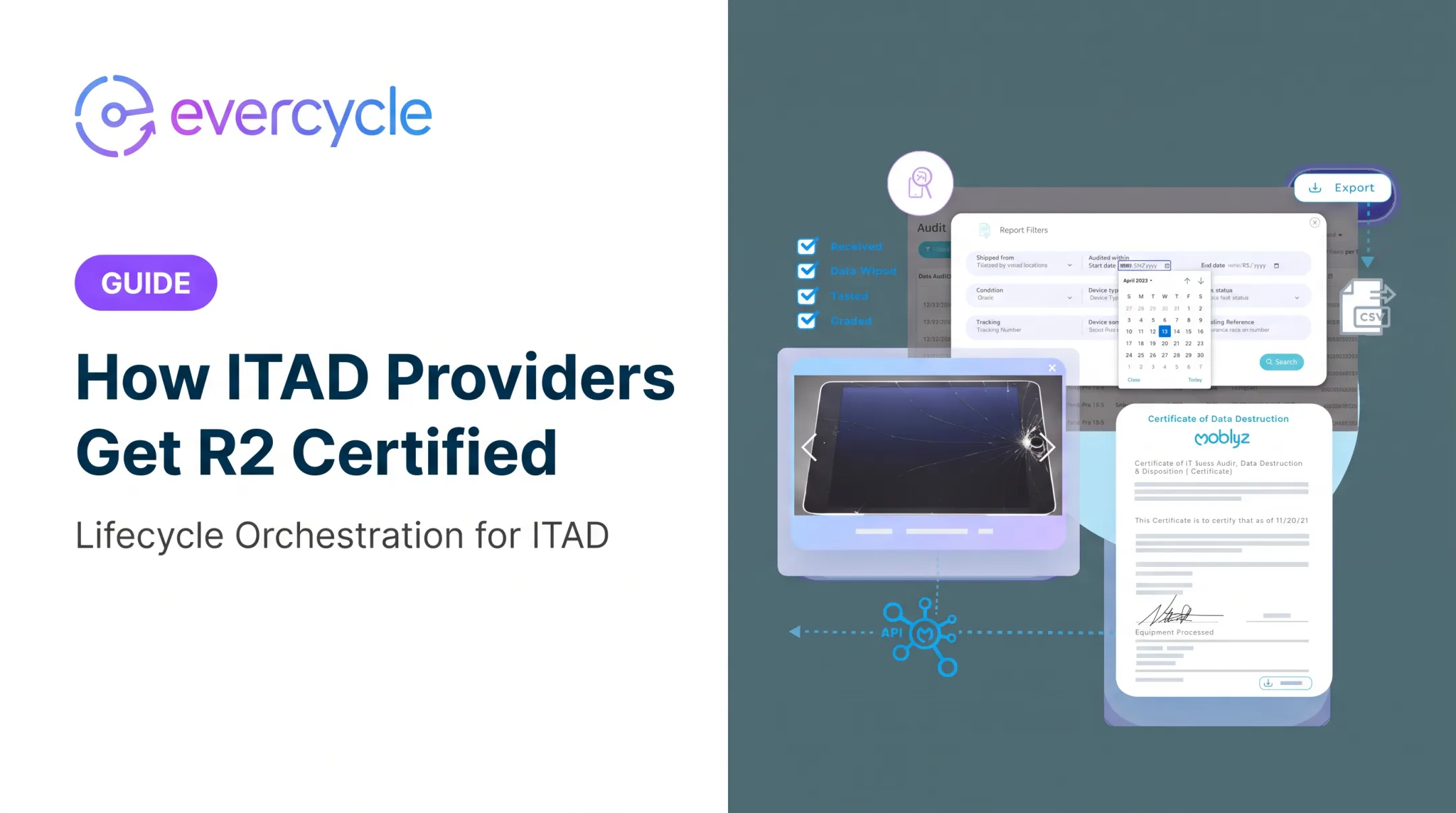
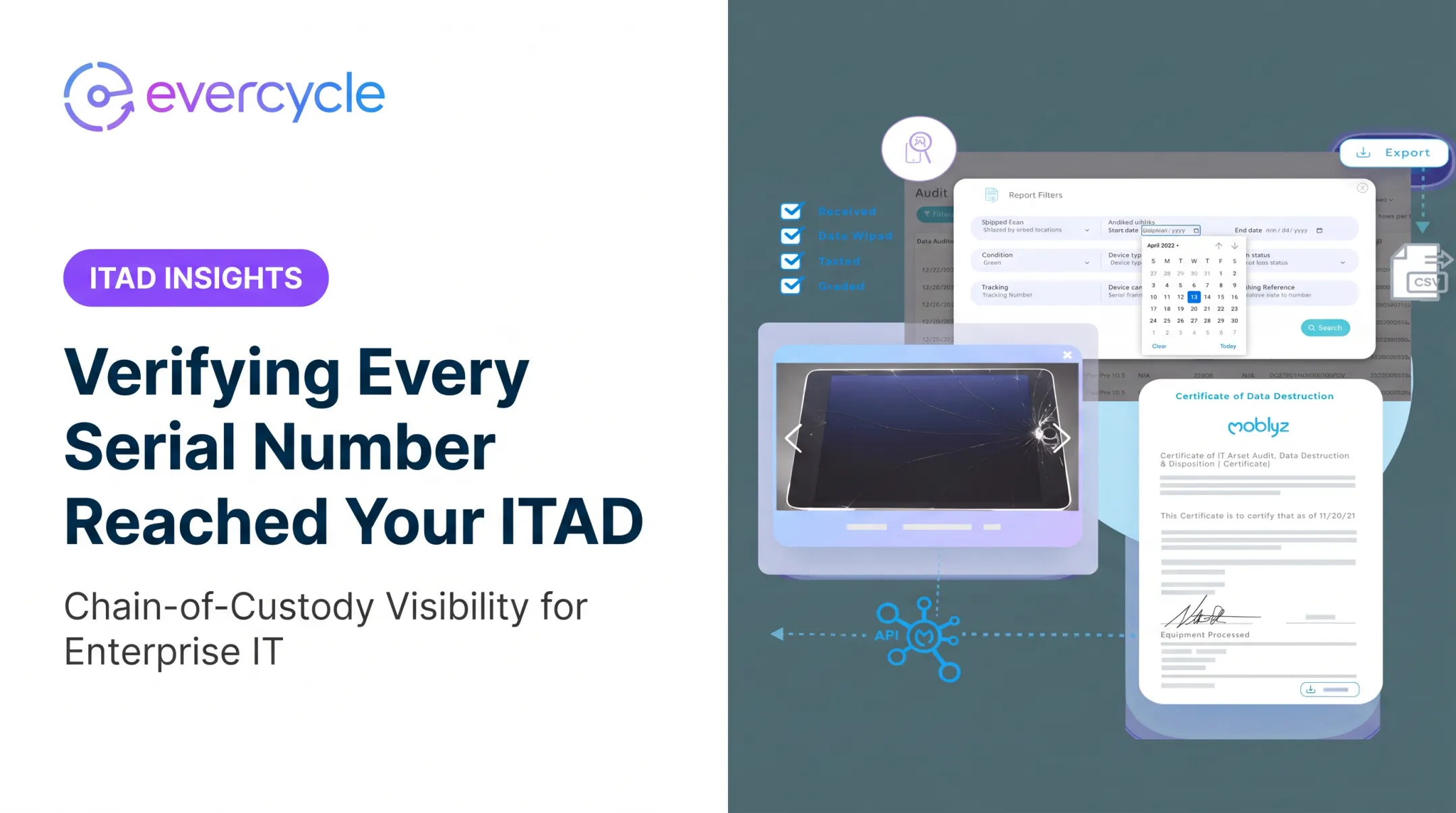
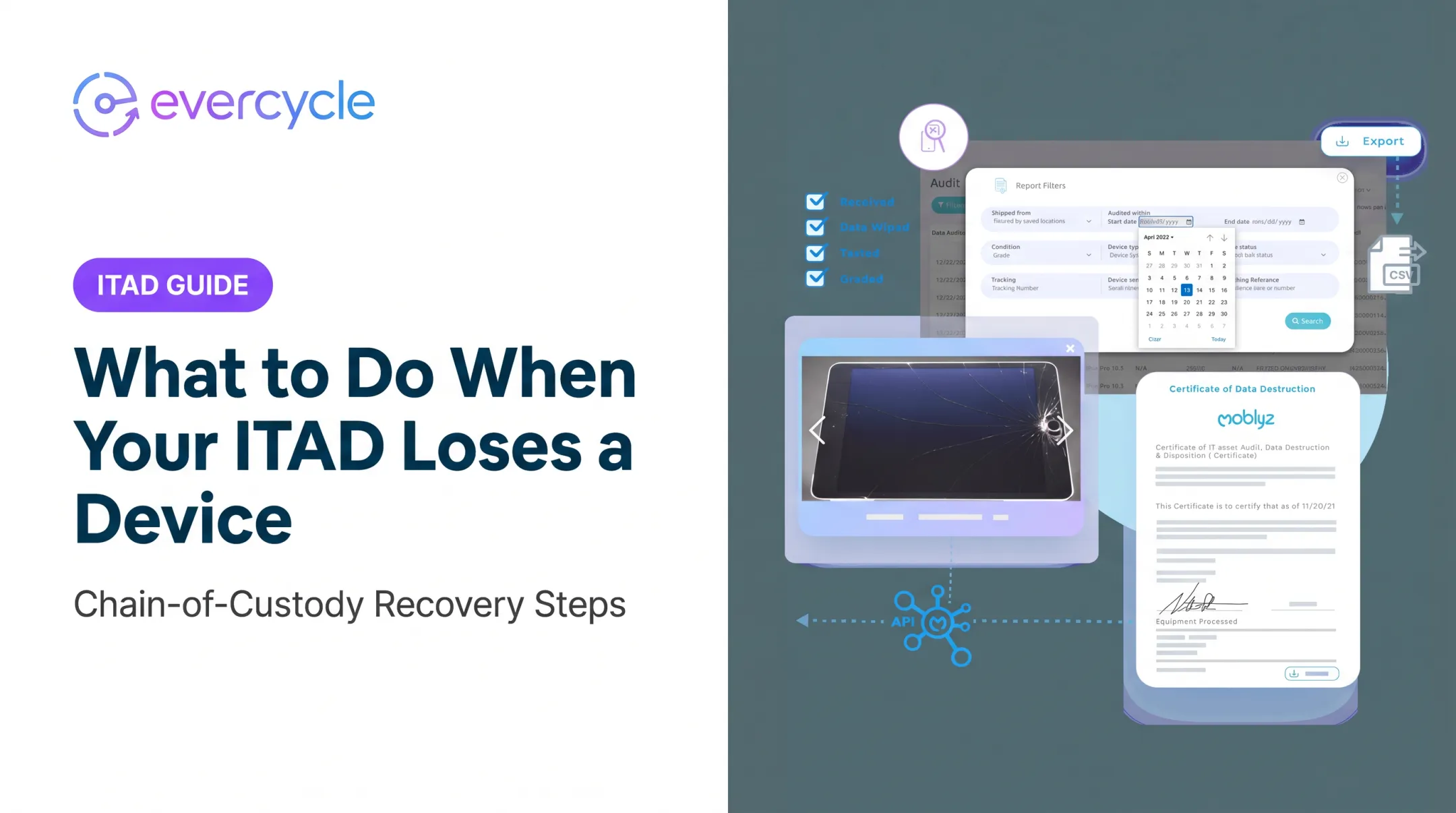
With several downstream providers, records scatter. An orchestration platform like Evercycle connects asset data, vendor events, chain-of-custody updates, and audit reporting across your existing workflows.
Its audit reporting shows audited devices with damage photos and certificates of data destruction. Results can be filtered, sorted, and exported. Evercycle provides visibility and coordination. It doesn't physically process or transport hardware.
Close Findings and Maintain Ongoing Oversight
Classify and Remediate
Rate each finding by risk. For each finding, record:
- Affected assets
- Root cause
- Owner
- Due date
- Required evidence
- Closure criteria
Separate documentation gaps from failures that could expose data or break custody.
Validate fixes with follow-up evidence, retesting, a site visit, or a focused re-audit. If material risk persists, escalate: add controls, restrict routing, invoke contract remedies, or replace the vendor.
Go Beyond the Annual Review
No rule sets one universal audit frequency. Regulatory guidance calls for audits and monitoring scaled to risk. Reassess when:
- A new subcontractor appears
- A facility or process changes
- A security incident occurs
- A certification expires
- Volume jumps materially
- Reconciliation exceptions repeat
Track Meaningful Indicators
No authoritative ITAD benchmark exists, so set measures against your own risk profile. Useful indicators include:
- Evidence completeness per batch
- Unresolved asset discrepancies
- Processing exceptions
- Incident response time
- Certificate quality
- Remediation timeliness
Frequently Asked Questions
What is an IT audit?
It's a systematic, independent, documented process for gathering evidence and evaluating it against criteria, applied to technology controls. A downstream ITAD audit narrows that to asset disposition controls.
What is the IT audit process?
Clarify scope and objectives, build an audit plan, define evidence-gathering procedures, test controls, and support conclusions. Findings then move to corrective action and follow-up validation.
What is a third-party audit?
An independent body, such as a certification body, assesses against a defined standard. A customer-led audit is second-party and tests your specific contract. A self-assessment is first-party and isn't independent.
What should an ITAD downstream vendor audit include?
Chain of custody, asset reconciliation, sanitization or destruction, physical security, environmental controls, subcontractors, documentation, incident response, and corrective action.
How often should downstream ITAD vendors be audited?
Base frequency on risk: data sensitivity, vendor criticality, prior findings, subcontracting, and process changes. Add event-triggered reviews after incidents or major changes.
What evidence should a vendor provide after processing assets?
Asset-level inventories, custody records, per-media sanitization or destruction certificates, verification logs, final disposition reports, subcontractor records, exception documentation, and any environmental or resale evidence.