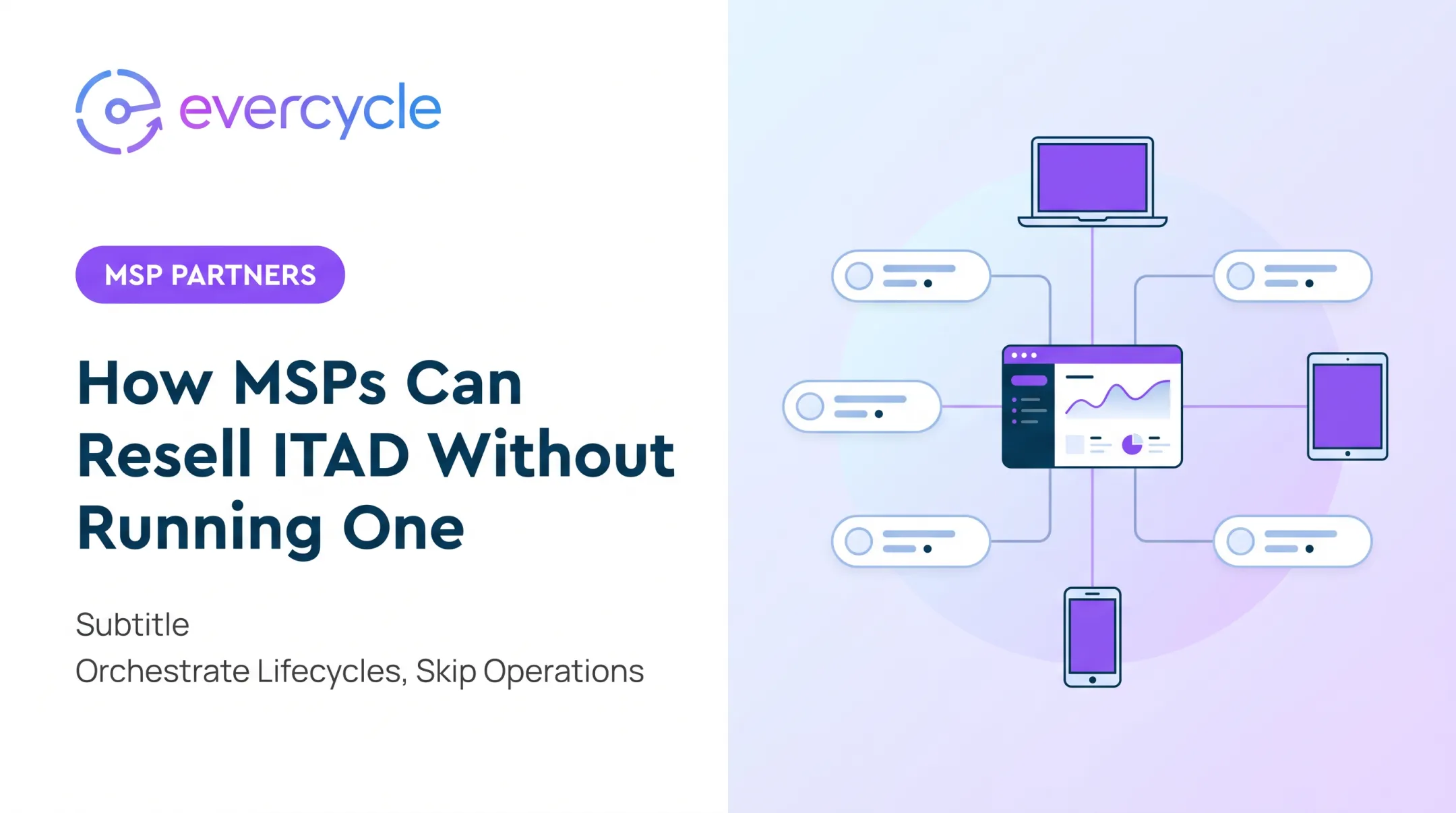
A white-label ITAD program is one answer. The MSP sells IT asset disposition under its own brand, while a specialist provider or software platform handles the operational work behind the scenes.
This guide covers why MSPs adopt the model, what a complete program includes, how to vet partners, and how to price and launch the offer.
Key Takeaways
- White-label ITAD lets MSPs add recovery and disposition services without building every capability in-house.
- A complete program links asset data, reverse logistics, sanitization, disposition, chain of custody, and reporting.
- Vet security evidence, integrations, branding controls, pricing transparency, and subcontractor oversight before signing.
- A small pilot validates demand, client experience, and margin before broad rollout.
What Is a White-Label ITAD Program?
What white-label ITAD means for an MSP
The MSP presents recovery and disposition services under its own name. An outside ITAD network, logistics provider, repair partner, or orchestration platform performs agreed portions of the work. ITAD here covers retrieval, intake, data sanitization, refurbishment, reuse, resale, recycling, and reporting.
White-label vs. private-label, outsourcing, and referrals
Branding is what makes a service white-label. Morgan Lewis describes white-label licensing as letting the licensee use its own brand and logo. It does not, by itself, assign custody, compliance, or liability.
| Model | What it means |
|---|---|
| White-label | A third party fulfills an offering the MSP presents as its own |
| Reseller/VAR | Buys and resells the vendor's offering, sometimes with services |
| Referral | Introduces a provider but doesn't sell the service |
| Outsourcing | Delegates execution; says nothing about branding |
Industry practice draws no consistent ITAD-specific line between white-label and private-label. Private-label physical products are a different topic. Whatever the model, settle who owns the customer relationship, billing, support, data, and liability in writing.
Division of responsibilities
Map responsibilities before launch:
- MSP: sales, pricing, account management, first-line communication
- Delivery partner: physical processing, sanitization, repair, recycling
- Platform: work orders, vendor routing, evidence, status updates
Put these boundaries in the partner agreement and the client-facing terms.
Why MSPs Use White-Label ITAD Programs
Wider service portfolio
ITAD fits naturally beside procurement, onboarding, offboarding, and endpoint management. Packaging recovery and disposition for existing clients beats sending them to an unrelated vendor.
Retention and differentiation
One accountable relationship simplifies life when devices leave the workforce or reach end of life. Branded portals, notifications, and reports keep the MSP visible beyond support tickets. Provider pages claim retention benefits, but no independent study confirms a retention lift, so test it in your own base.
Lower build cost and complexity
An in-house operation needs:
- Shipping workflows
- Warehouse coordination
- Sanitization procedures
- Remarketing relationships
- Exception handling
- Reporting
Managing a partner is lighter. No authoritative benchmark exists for in-house build cost, so get real quotes before comparing.
Security and audit readiness
Exposure is real. The SEC's 2022 action against Morgan Stanley Smith Barney involved a moving company with no data-destruction expertise. That vendor decommissioned thousands of drives and servers. Some were later sold with unencrypted customer data, and the firm agreed to a $35 million penalty.
Document every handoff, transport event, sanitization action, and final disposition. Useful evidence includes:
- Certificates
- Serial-level records
- Exception logs
- Timestamps
Compliance scope varies. The FTC Safeguards Rule covers financial institutions, not every MSP, and requires covered entities to dispose of customer information securely and to assess their service providers. HIPAA requires policies for final disposition of ePHI without prescribing one method.
Reuse and recovered value
A documented process can favor redeployment, repair, refurbishment, and resale before recycling. Recovered value may be credited, shared, or reported. Don't promise a return until device condition, market demand, fees, and contract terms are known, since no authoritative U.S. resale-yield benchmark exists.
What Should a White-Label ITAD Program Include?
Asset intake and visibility
Capture each asset’s core fields at intake:
- Identifiers, ownership, and user or location
- Condition, status, and requested action
- Final outcome once work completes
Look for integrations or reliable imports and exports with your PSA, RMM, CMDB, procurement, HR, and endpoint-management tools.
Retrieval and reverse logistics
An offboarding or refresh event should become a work order automatically. From there, the employee or site gets instructions and shipping materials, pickups are scheduled, and shipments are tracked through confirmed receipt.
Define escalation for failed pickups, missing or damaged devices, and unresponsive users. Someone must own each one.
Sanitization and chain of custody
NIST SP 800-88 Rev. 2, published September 2025, is the current baseline. Its methods are Clear, Purge (including cryptographic erase), and Destroy. It calls for a certificate on each sanitized medium under organizational policy, covering fields such as make, model, serial number, method, and validation.

That is guidance, not a universal mandate. Still, require:
- Identification of data-bearing equipment
- A method matched to the media
- Asset-level results
- A defined path for devices that fail sanitization
IEEE 2883-2022 is a related standard for sanitizing storage.
Repair, reuse, resale, and recycling
Build a decision tree that covers redeploy, repair, refurbish, remarket, donate where appropriate, or recycle. Ask providers about:
- Grading and parts harvesting
- Environmental controls
- Downstream-vendor oversight
The MSP and client should both receive disposition records. EPA separates refurbishment and reuse from recycling and recommends certified recyclers for businesses.
Branding and customer experience
Require branded touchpoints across the program:
- Emails, portals, forms, and domains
- Role-based access and custom statuses
- Client-specific workflows
The experience should look the same whether three carriers or five processors touch the device.
Reporting and commercial visibility
Require dashboards and exports for:
- Open work orders and aging exceptions
- Sanitization evidence and final disposition
- Turnaround time
- Client billing
Separate internal MSP views from end-customer views, and reconcile provider charges, platform fees, credits, and recovered value.
How to Choose a White-Label ITAD Partner
Physical capability and coverage
Match the partner to your device types, volumes, locations, packaging, and repair needs. Ask about facilities, carriers, downstream processors, overflow capacity, and subcontractor oversight. Don't assume broad coverage.
Security and compliance controls
Request current documentation on access controls, facility security, sanitization, media destruction, incident response, insurance, retention, and evidence delivery. Verify every claim directly, since requirements vary by service and jurisdiction.
| Credential | What to check |
|---|---|
| R2v3 | Site and scope in SERI's directory; confirm any Appendix B (serial-level tracking) claim |
| e-Stewards | Current facility certificate and scope; downstream vetting |
| NAID AAA | Service and media endorsements in i-SIGMA's locator |
| ISO/IEC 27001 | Certificate, site, scope; not ITAD-specific |
| SOC 2 | Report scope and period; not a facility certification |

No authoritative source sets standard liability caps, insurance minimums, or indemnity terms. Negotiate them rather than assuming a market norm.
Technology and integration fit
Assess APIs, webhooks, imports and exports, asset-level tracking, automated routing, status histories, and role permissions.
An orchestration layer such as Evercycle suits MSPs wanting unified visibility across existing ITAD, logistics, and repair providers without replacing each one. Evercycle doesn't process or ship hardware itself; it coordinates the providers that do.
It offers configurable branding, REST APIs, webhooks, and integrations with tools like ServiceNow and Jamf.
White-label and commercial controls
Review logo and domain customization, client ownership, escalation, service levels, wholesale rates, minimums, cancellation, liability, and resale-value treatment. Also settle whether the partner may contact your customers directly.
Watch for hidden fees:
- Shipping and storage
- Failed pickups
- Data destruction, testing, and special handling
Due diligence and pilot testing
- Review sample certificates and reports
- Check references from comparable programs
- Map a full test workflow
- Measure recovery completion, cycle time, and exception rate
- Compare evidence availability, client satisfaction, cost per device, and recovered value to your baseline

How to Launch and Price the Offering
Define the initial package
Start narrow: employee offboarding recovery, refresh-cycle retrieval, repair coordination, or full disposition. Pick the client size, device types, locations, and escalation rules you can support before adding complexity.
Build unit economics first
List every cost input:
- Platform licensing and provider fees
- Packaging, transportation, and storage
- Sanitization, repair, and recycling
- Support, account management, and payment processing
- Exception handling
Model target margin and break-even from actual quotes and expected volumes. Decide whether resale value is retained, shared, or credited to the customer.

Published prices only show how wide the variables run. One provider, Trace, lists drive destruction from $15 per drive and a $39 mail-in kit. That is one vendor's offer, not a market rate.
Wipe versus destruction, mail-in versus pickup, and shipment thresholds all change the number. Treat any single quote as a data point, not an MSP ITAD margin benchmark.
Pilot, enable sales, expand
Build the sales and delivery kit first:
- One-pager and discovery checklist
- Statement of work and onboarding sequence
- Escalation matrix and reporting template
Use pilot results to refine pricing and service levels. MSPs that want a vendor-neutral orchestration layer can evaluate Evercycle for branded recovery, repair, and disposition workflows across existing systems.
Frequently Asked Questions
What is white label software?
Licensed technology made by one company and rebranded, configured, and resold by another. Verify branding controls, support duties, integrations, data ownership, and contract terms.
How much does a white label cost?
It depends on scope, user or asset volume, integrations, support, branding, and contract structure. Compare total cost of ownership, not just the subscription or per-device rate.
How much do MSPs cost?
MSP pricing can mean a recurring management fee, project fee, or ITAD charge. Costs vary with devices, users, service levels, logistics, and security needs, so request an itemized proposal.
What is white-label ITAD?
Recovery, secure disposition, and related lifecycle services delivered by a specialist behind an MSP's brand. Scope may include logistics, sanitization, repair, reuse, resale, recycling, and reporting.
How does a white-label ITAD program benefit an MSP?
It speeds service expansion, reduces operational burden, widens lifecycle coverage, and documents chain of custody. It can also open new revenue or retention opportunities when client demand and pricing support them.
What should an MSP verify before choosing a provider?
Security evidence, processing capability, integrations, branding controls, pricing transparency, service levels, downstream oversight, data ownership, references, and pilot terms.