Losing a device is bad. Losing the proof of what happened to it is worse, because that's what auditors, customers and security teams ask for.
This article is for US enterprise device fleets. Device chain of custody differs from courtroom evidence handling: it tracks IT assets through their lifecycle, not forensic evidence. Below, we cover where records break and the operational, security, audit, financial and sustainability consequences. We also cover how to prevent and respond to a break.
Key Takeaways
- Device chain of custody is the chronological record of an asset's identity, handlers, condition, transfers and disposition.
- Breaks cluster around offboarding, shipping, repair, vendor handoffs and sanitization.
- The core risk is losing the ability to prove what happened, not only losing hardware.
- Standard workflows, verified identities and one central record close most gaps.
What Device Chain of Custody Actually Covers
For IT assets, chain of custody is an asset-level record that connects one physical device to its custodians, handoffs, sanitization outcome and final disposition. No single regulation defines it this way. It is a synthesis of requirements.
e-Stewards Standard V4.1 requires organizations to define where their custody chain starts and ends and to keep equipment-specific processing records.
NIST's forensic glossary also defines "chain of custody," but that definition covers evidence handling. Don't treat it as an IT asset tracking standard.
Establish identity before anything moves
Capture baseline facts at assignment or retrieval:
- Serial number and asset tag
- Make and model
- Assigned user or site
- Condition and accessories
- Starting status
IAITAM guidance names serial number, make and model as the physical identity attributes of an asset record. If identifiers are missing or conflict, every later event becomes ambiguous.
Document every handoff and status change
Each transfer needs:
- Releasing and receiving parties
- Date, time, and location
- Carrier or work order reference
- Condition and package status
- Next responsible action
A status update with no accountable owner is not a complete custody event.
Track storage, access and exceptions
Custody doesn't pause while a device sits in a staging area, repair depot or vendor warehouse. Record the storage location, who accessed the device, and any delay, damage, loss or failed delivery. Each exception needs an investigation trail.
Tie disposition evidence back to the original asset
Sanitization certificates, repair records, resale paperwork and recycling reports must map to the original device. NIST SP 800-88 Rev. 2 calls for a certificate per item, including:
- Manufacturer, model, and serial number
- Sanitization method, tool, and version
- Verification method
- Verifier's name and signature
A generic batch record may not prove what happened to one particular laptop.

Where Device Chain of Custody Breaks
Missing, delayed or contradictory records
Late entries, missing timestamps, unsigned handoffs, duplicate asset records and conflicting statuses all blur who is responsible. The gap between recovery, receipt and disposition is where devices tend to vanish on paper.
Device identity mismatch
Unreadable labels, wrong serial numbers, duplicate asset tags, swapped devices or a laptop logged under the wrong employee cut the link between hardware and record.
Picture a returned laptop that arrives at an ITAD partner. The label is scuffed, the serial was keyed in wrong at offboarding, and the shipment lists three similar models. Now nobody can confidently match it to the employee, the shipment or the sanitization certificate.
Uncontrolled vendor and logistics handoffs
Carriers, repair providers, MSPs, ITAD vendors and recyclers often run separate portals and update at different times. When email and spreadsheets serve as the primary record, custody gets pieced together after the fact. That is hard to defend in an audit.
Unlogged access, repair or condition changes
Custody breaks again when someone reimages a device, swaps a drive, pulls parts or opens it without logging the event. Those component swaps and condition changes can alter identity, security posture and value.
Lost, diverted or prematurely disposed devices
The worst failures are physical:
- Cannot be located after recovery or transfer
- Sent to the wrong destination
- Left with an employee after offboarding
- Disposed of before sanitization evidence exists
- Recycled with no asset-level record
An Oomnitza-sponsored survey of 213 senior IT professionals found that 49% had lost at least 5% of technology assets when workers left, and 27% had lost more than 10%. It is self-reported and vendor-sponsored, so treat it as directional.
The Real Risks of a Broken Chain of Custody
Data privacy and security exposure
Without a trail, you can't show who controlled a device, whether it was secured in transit or whether data was wiped before reuse. The SEC's 2022 order against Morgan Stanley Smith Barney is the cautionary tale. A vendor sold roughly 4,900 IT assets, including unwiped drives. Forensic analysis of 13 recovered drives found at least 140,000 pieces of customer PII, and most drives from the decommissioning stayed missing.

Requirements depend on your sector:
- HIPAA: 45 CFR 164.310(d) calls for records of hardware and media movements and the person responsible.
- FTC Safeguards Rule: applies to financial institutions in FTC jurisdiction and requires secure disposal of customer information.
- PCI DSS 4.0.1: Requirement 9.4.7 covers destruction of media holding cardholder data.
- State laws: California Civil Code 1798.81 and New York GBL 899-bb require reasonable disposal measures.
None applies to every enterprise. Check which ones cover you.
Loss of a device doesn't automatically trigger breach notification either. HIPAA and California law turn on specific statutory elements, such as encryption status and a documented risk assessment. Without custody records, though, you can't run that assessment well.
Audit, compliance and investigation risk
Auditors, customers, insurers and security teams want evidence linking an asset to its handling and disposition. Having a policy is not the same as producing a reliable asset-level record that shows it was followed. AICPA's Trust Services Criteria CC6.5, for example, expects protections over physical assets to end only after data can no longer be read or recovered.
A federal example: a Federal Reserve OIG audit found 677 untagged or unassigned laptops worth $1.447 million. Those are audit-specific findings, not national rates.
Financial and recovered-value loss
Lost, misrouted or over-aged devices lose resale value. Wrongly classified recycling forfeits it. Weak traceability also makes it hard to reconcile vendor charges or settle who was responsible. Evercycle's own figures put unrecovered-device losses at about $1,500 per device.
For context, IBM puts the global average data breach at $4.99 million. That figure isn't specific to device loss.
Operational disruption and inaccurate inventory
Unreliable custody events create duplicate tickets, repeated employee outreach, delayed offboarding and unnecessary replacement purchases. IT, HR, procurement and finance each reconcile by hand. One industry survey found 56% of respondents reported CMDB accuracy of 85% or lower.
Sustainability and reputational consequences
You can't support reuse, recycling or ESG claims if the final destination is unknown. Documented disposition is not the same as assumed responsible disposal. For scale, the Global E-waste Monitor 2024 reports 62 million tonnes of e-waste generated in 2022, with 22.3% documented as formally collected and recycled. Those are global totals, not enterprise rates.

How to Prevent and Respond to a Break
Build a standard control model
Define the rules once and apply them to employee devices, distributed hardware and field equipment. NIST SP 800-53 CM-8 calls for an accurate, current inventory, and MP-6(1) for sanitization actions that are reviewed, tracked and verified.
A starter checklist:
- List required lifecycle events: assign, retrieve, ship, receive, repair, store, sanitize, dispose.
- Set one owner per stage.
- Require serial number and asset tag at every event.
- Standardize handoff fields: parties, timestamp, location, condition, reference number.
- Define exception categories and approval points.
- Set retention periods for records and certificates.

Centralize cross-vendor visibility and audit reporting
Rules fail when records live in five places. An orchestration layer pulls asset data, logistics, employees and existing providers into one workflow, so each custody event is visible in one place.
Evercycle coordinates lifecycle actions, vendor routing, real-time chain-of-custody tracking and audit reporting across your existing systems and providers. It doesn't physically process or ship devices.
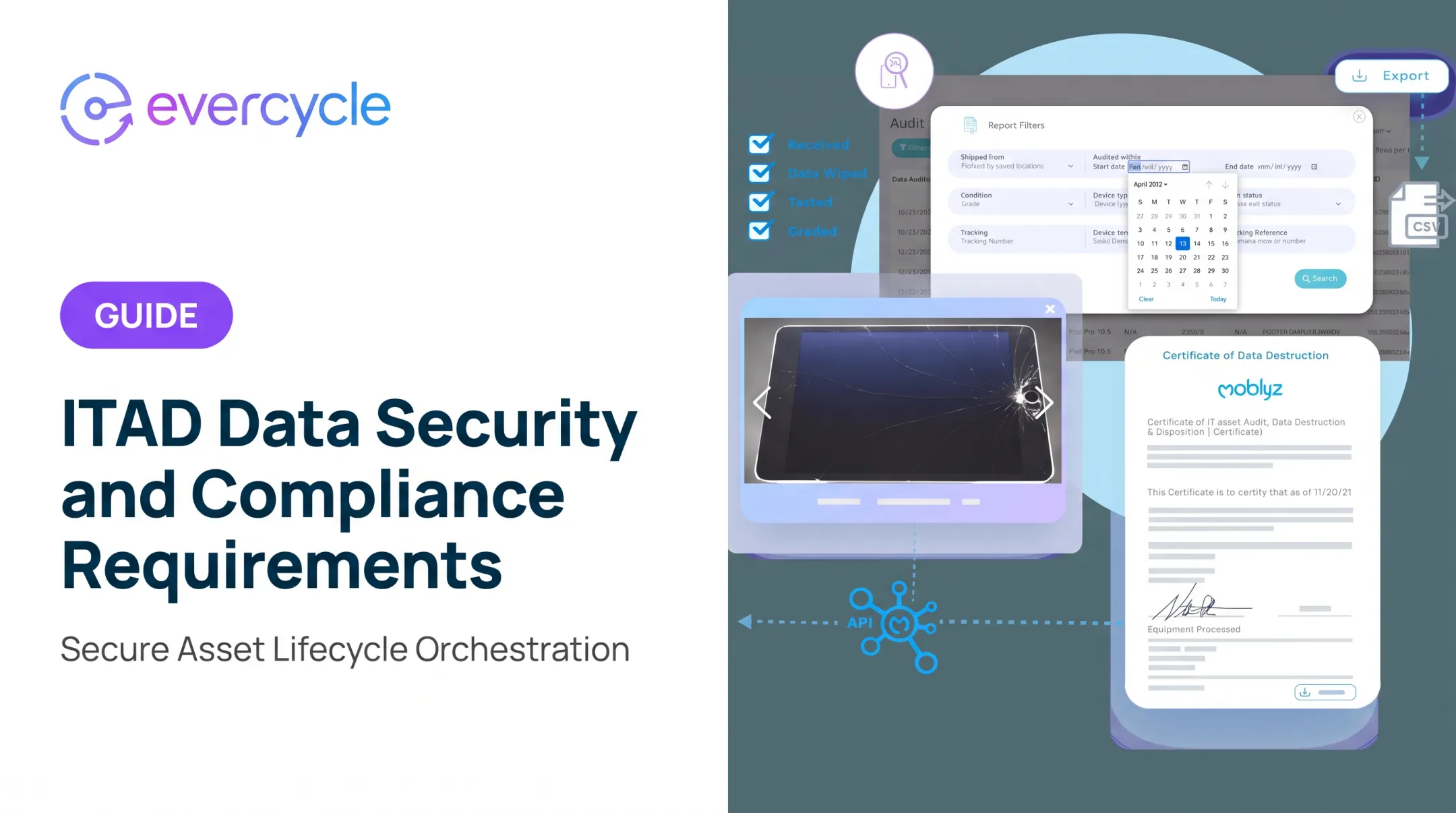
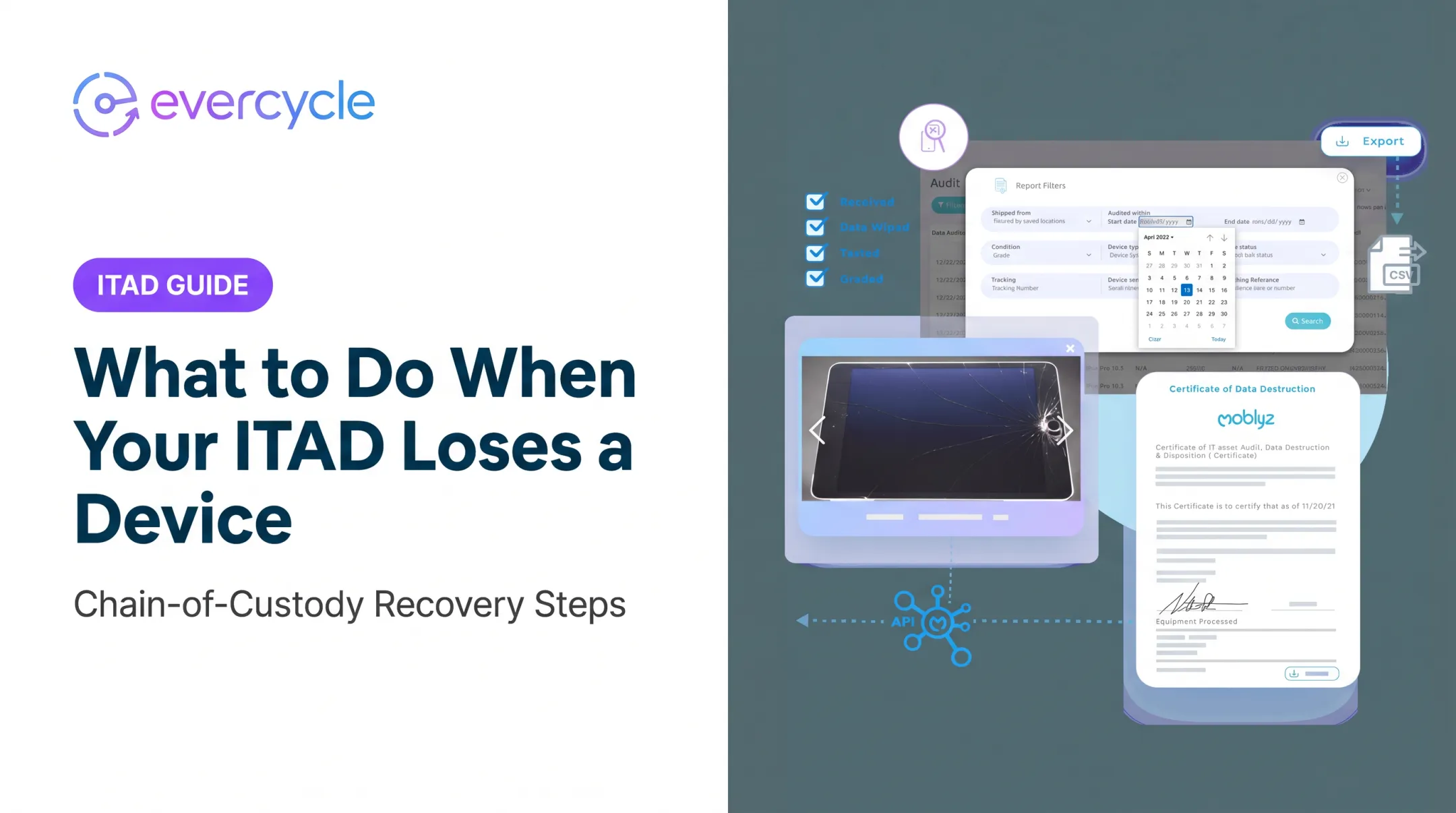
Its audit reports can include device specs, journey, data-erasure results, condition images and a Certificate of Data Destruction. For offboarding, it can trigger recovery from HRIS, MDM or CSV events. Evercycle reports recovery rates of 90%+ with automated escalation, compared with 20 to 30% of devices that never return without it, based on its internal figures.
Establish a break-response playbook
When a break surfaces, work through five actions:
- Flag the exception in the record immediately.
- Secure or locate the device, including contacting the vendor or employee.
- Preserve relevant records: shipping data, tickets, certificates, emails.
- Determine obligations: assess whether data was exposed and whether privacy, contractual or reporting duties apply.
- Document corrective and preventive actions so the same gap doesn't reopen.

Escalate to security, privacy, legal, procurement or compliance when the facts or contract terms call for it.
Frequently Asked Questions
How do you complete a chain of custody?
Identify the device, record every custody event and status change, and document secure storage and access. Then link sanitization and final disposition evidence to the original asset.
What are the implications of a broken chain of custody?
You may be unable to locate the device or prove it was sanitized. That brings audit and contractual concerns, operational disruption, financial loss and possible security escalation.
What breaks the chain of custody?
Missing or contradictory records, identity mismatches, undocumented transfers and unauthorized access. Lost devices, improper storage and disposition records that can't be tied to a specific asset do the same.
What does it mean to break the chain of custody?
You can no longer reliably establish continuous identity, control, location or responsibility for a device during a lifecycle stage.
What is included in a chain of custody?
Asset identifiers, handlers, timestamps, locations, condition and transfers. It also covers storage, access, repairs, sanitization, exceptions and final disposition.
What does "chain of custody" mean?
It's the chronological, auditable history of who controlled an asset, where it moved, what happened to it and how its lifecycle ended.