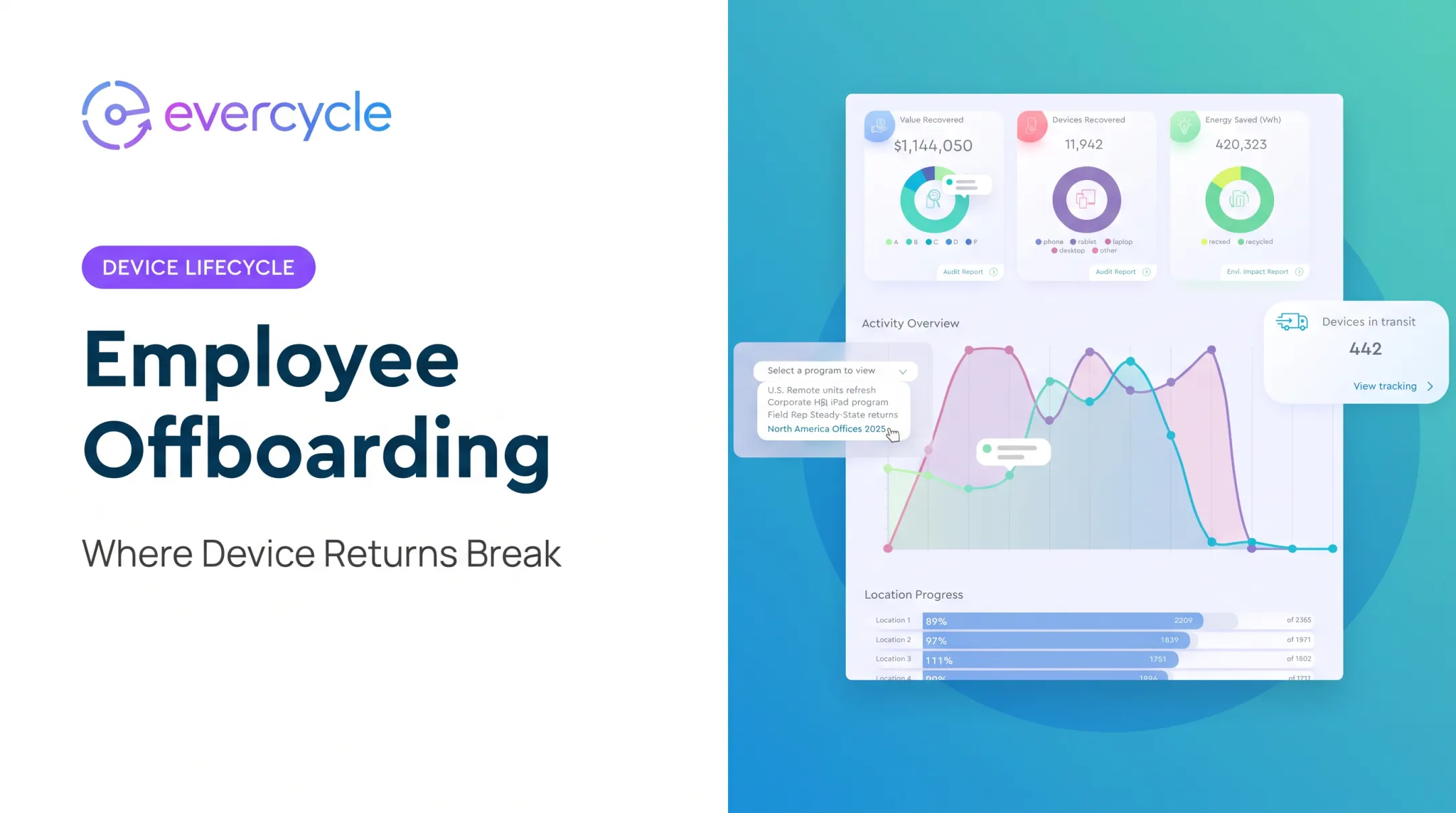
That scenario is common, and a device list does not solve it. A YouGov survey commissioned by Oomnitza found that 27% of senior US IT professionals reported losing more than 10% of their technology assets during offboarding. This guide explains why visibility breaks and how to rebuild it across the full device lifecycle.
Key Takeaways
- Reliable visibility connects identity, ownership, location, status, history and control evidence.
- Fragmented systems, manual updates, remote work, vendor handoffs and unclear ownership break it.
- The fix: consistent data, integrated systems, automated lifecycle events and accountable exception workflows.
- Better visibility means faster recovery, audit readiness, more reuse and smarter hardware decisions.
What IT Asset Visibility Actually Means
A practical definition
IT asset visibility is the ability to see and trust what assets exist, where they are, who is responsible for them, what condition they are in and what has happened to them. IAITAM frames it as knowing what you have, where it is and how good the data is.
An inventory records information. Visibility connects current information to decisions, workflows and required actions.
What a complete asset view connects
- Identity: durable identifier, serial number, model, type
- Ownership and context: assigned user, department, business unit, responsible provider
- Location and status: where it is now and what state it is in
- History: lifecycle events, warranty, security state, sanitization and disposition evidence
NIST SP 800-53 (CM-8) lists inventory fields such as serial number, manufacturer, supplier and physical location. These must stay linked, not scattered across unreconciled records.
Visibility across the lifecycle
An asset moves through procurement, deployment, assignment, repair, replacement, recovery, reuse, recycling or final disposition. Gaps appear when it changes hands: between employees, offices, warehouses, repair providers, logistics partners or ITAD vendors.

Who depends on it
- IT asset managers use it for planning and control.
- Security and compliance use it for data protection, chain of custody and audit evidence.
- HR and People Ops need it for onboarding and offboarding.
- Finance uses it for budgeting and depreciation reviews.
- Service providers coordinate work across customers and vendors.
A quick reliability test
Ask whether your team can:
- Identify every active device
- Locate a specific assigned laptop
- Confirm its current owner
- Verify its last lifecycle event
- Produce disposition evidence
A record is not truly visible if it is outdated, has no accountable owner, or cannot trigger the next required action.
Why IT Asset Visibility Breaks
Fragmented systems create conflicting records
Procurement platforms, CMDBs, endpoint tools, HR systems, shipping records, spreadsheets and ITAD portals each hold part of the picture. An EMA and ServiceNow report found asset, financial and service-planning data commonly lived in at least four sources. The report is older and vendor-associated, and it covers broader IT data, yet the multi-source pattern still holds.
Naming conventions, identifiers and update timing differ, so each system tells a slightly different story.
Manual updates compound errors
When people must update spreadsheets, email threads or portals after every movement, records drift. Typical failures:
- A device marked as shipped but never received
- A replacement still assigned to a former employee
- A retired asset still showing as active
Remote fleets are harder to reconcile
Home offices, temporary workers, field equipment and branch locations make physical distance a real problem. Confirming possession, condition and return status requires structured workflows and clear event owners. Cascade's 2024 survey found 43% of respondents had more than 20% of their workforce remote.
Handoffs are the blind spots
The riskiest moments sit between lifecycle stages:
- Procurement to deployment
- Offboarding to recovery
- Recovery to repair
- Repair to redeployment
- Disposition to final reporting
Each handoff needs:
- A responsible party
- Required data fields
- A timestamped event
- An escalation path if nothing happens

Weak governance makes bad data acceptable
Without a defined system of record, data standards, reconciliation cadence and access controls, nobody owns corrections. Define up front:
- Which data is authoritative
- Who may change it
- How exceptions get resolved
- How vendors are held accountable
What Poor IT Asset Visibility Costs
Operational disruption
Missing records slow provisioning, replacement, troubleshooting and recovery. IT ends up searching messages and contacting multiple providers for basic answers. Without a single source of truth, device refreshes can stretch for months while staff spend hours emailing employees for status. No reliable cross-industry dollar figure exists for manual ITAM cost, so measure your own recovery time.
Security, compliance and audit exposure
Incomplete visibility leaves you with:
- Unknown devices on the network
- Unverified sanitization at end of life
- Unclear chain of custody
- No proof of what happened to retired hardware
HHS requires covered entities to have procedures to remove ePHI from media before reuse. In one HHS case, Affinity Health Plan paid $1,215,780 after hard drives in leased photocopiers were returned without erasing ePHI.
Visibility alone does not satisfy HIPAA or any other regulation. But NIST SP 800-88 Rev. 2 calls for a certificate of sanitization for each medium sanitized, and you cannot produce what you never tracked.
Lost value and waste
When condition and location are unknown, teams buy replacements they did not need, miss reuse and lose resale value. Sage's 2026 benchmark reported 2025 server resale values nearly 2.5 times their seven-year average, though that reflects one provider's data. Globally, only 22.3% of e-waste was documented as properly collected and recycled in 2022.

How to Fix IT Asset Visibility
Establish a baseline and scope
Start by listing every category that matters:
- Employee devices
- Networking gear and servers
- Peripherals and field hardware
- Third-party-managed equipment
Then reconcile systems, physical records, and vendor-held data. Document unknown, duplicate, inactive, and missing assets.
Create a consistent data model
Require at minimum:
- Durable identifier and type
- Owner and location
- Status and condition
- Lifecycle stage and security state
- Responsible provider
Standardize status values. "In repair," "awaiting pickup," "received," and "ready for redeployment" must mean the same thing to every team and vendor. CIS Controls v8.1 adds asset owner and department as inventory fields.
Connect systems and providers
Sync HR, procurement, endpoint, service management, logistics, warehouse, and ITAD systems instead of forcing re-entry. With multiple providers or distributed fleets, an orchestration layer helps.
Evercycle is one example: it integrates with tools such as ServiceNow, Intune, Jamf, and HRIS platforms, routes work to providers, and maintains lifecycle traceability. Existing systems stay authoritative for data they own, and Evercycle does not physically process or ship hardware.
Automate lifecycle events
Map the events that should update a record:
- Assignment, shipment, and delivery
- Repair intake and completion
- Recovery request and receipt
- Sanitization and final disposition
Use automated employee messages, vendor work orders, and escalations (for example, reminders at Day 3, 7, and 14) so the next action is always clear.

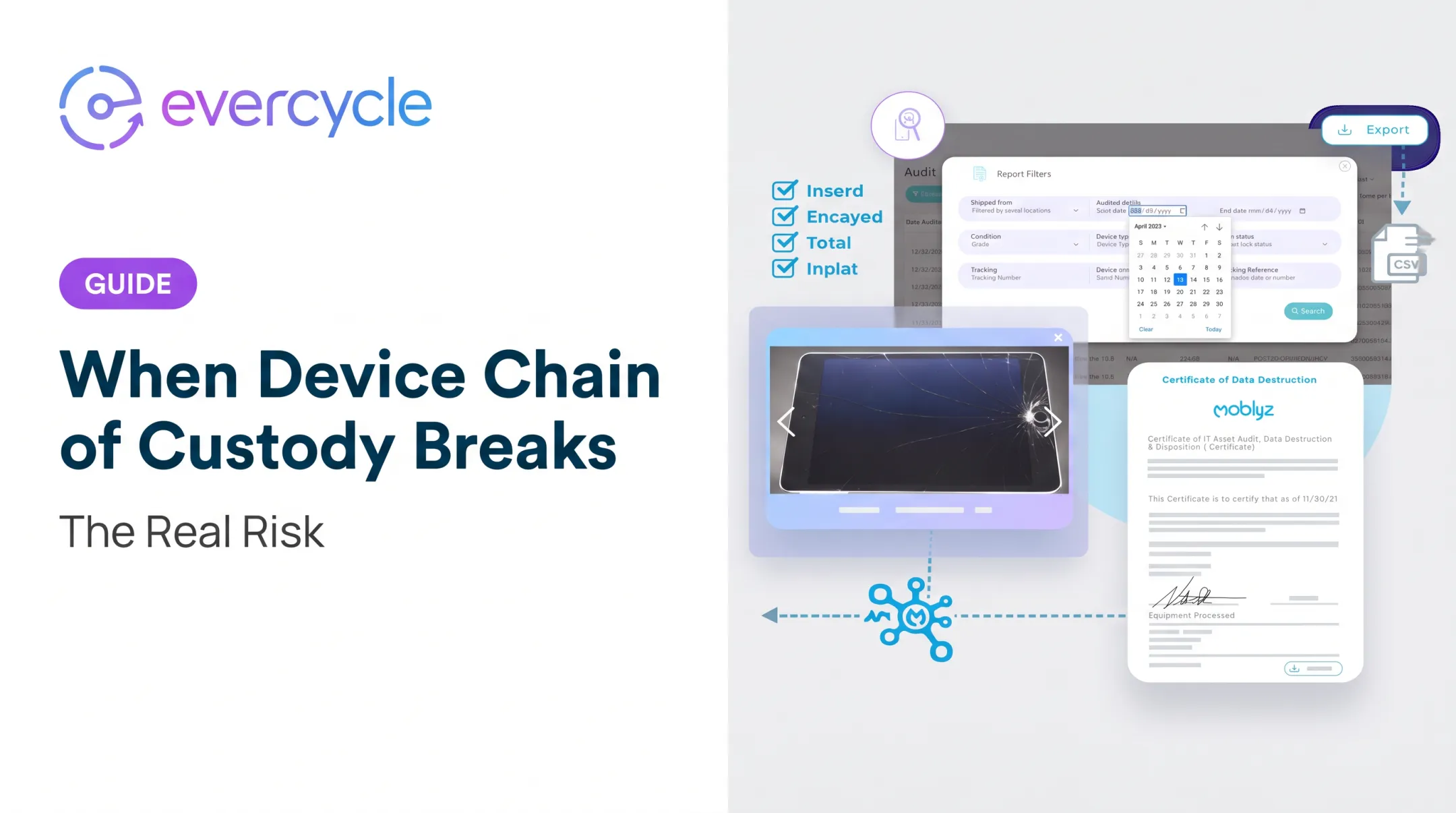
Protect chain of custody
For any asset holding organizational data, require timestamped records of possession changes, pickups, provider actions, sanitization, and disposition. Role-based access, audit logs, and documented exception handling preserve accountability without giving everyone edit rights.
Build dashboards around exceptions
Surface assets that need attention:
- Unknown owners or locations
- Overdue recoveries and stalled repairs
- Mismatched records or missing evidence
- Devices nearing replacement
Start with a focused pilot, validate the model, then expand by asset category, business unit, or provider. Avoid an all-at-once overhaul.
How to Make Visibility Last
Define ownership and review routines
Assign data quality and lifecycle actions across IT, HR, security, finance, procurement, and providers using a responsibility matrix per event.
- Set a recurring reconciliation cycle. NIST leaves frequency to the organization, while CIS suggests reviewing inventory at least bi-annually.
- Document escalation for assets that stay unassigned, unlocated, unrecovered, or unsupported.
Measure visibility as an outcome
| Measure | Helps you decide |
|---|---|
| Record completeness | Where data standards fail |
| Reconciliation accuracy | Which systems to trust |
| Time to confirm location | Whether workflows work |
| Recovery cycle time | Where handoffs stall |
| Unresolved exceptions | Where to add staff or escalation |
| Disposition evidence availability | Audit readiness |
| Reuse rate | Purchasing and resale strategy |

No reliable cross-enterprise benchmarks exist for these, so track trends against your own baseline.
Keep workflows aligned with change
Review processes when you change hiring models, offices, endpoint policies, vendors, repair programs, or compliance requirements. Visibility lasts through consistent events, accountable people, and connected workflows, not a one-time inventory exercise.
Frequently Asked Questions
What is total asset visibility?
Total asset visibility is a trustworthy, connected view of assets across identity, ownership, location, status, lifecycle history, and control evidence, from deployment through disposition.
What does visibility mean?
Visibility means knowing what is happening with an asset now, what happened before, and what action comes next, rather than only having a record somewhere.
What is an IT asset?
Laptops, desktops, mobile devices, servers, networking equipment, peripherals and connected hardware. Each organization should define its own scope, including software and services if relevant.
What are the four components of an IT asset?
No canonical four-part breakdown exists in public ITAM standards. A practical model covers identity, ownership and context, current state and location, and lifecycle and control history. IAITAM's four items (visibility, accountability, governance, lifecycle control) describe program capabilities, not asset components.